Try, learn and adjust
Check the radio script and airing schedule
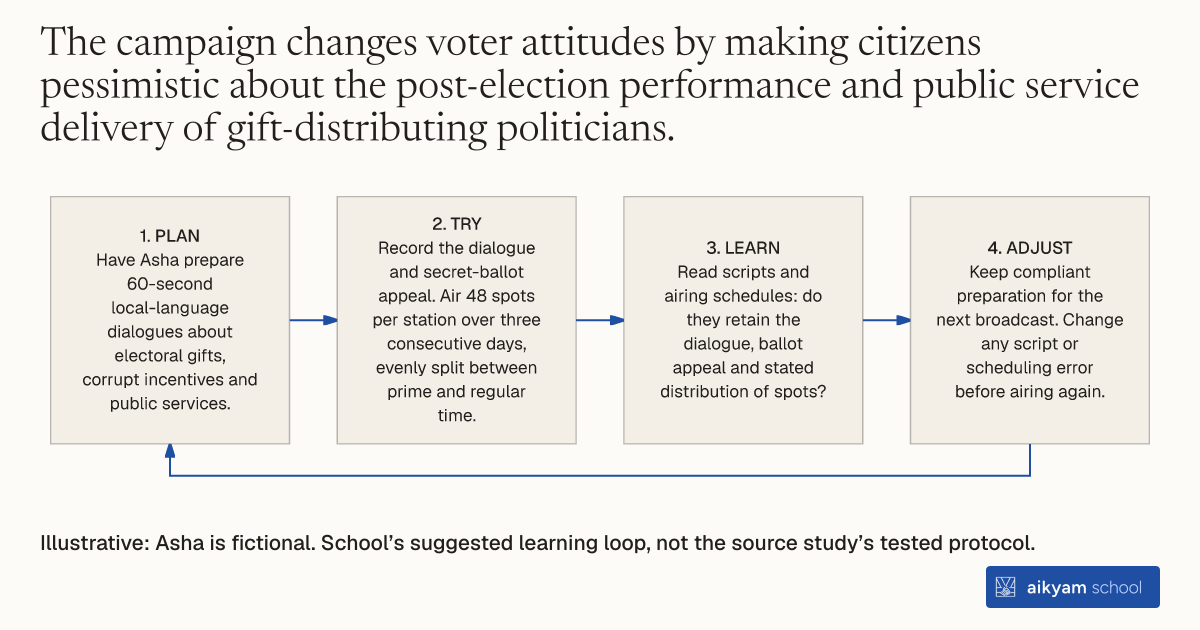
- Plan: Have Asha prepare 60-second local-language dialogues about electoral gifts, corrupt incentives and public services.
- Try: Record the dialogue and secret-ballot appeal. Air 48 spots per station over three consecutive days, evenly split between prime and regular time.
- Learn: Read scripts and airing schedules: do they retain the dialogue, ballot appeal and stated distribution of spots?
- Adjust: Keep compliant preparation for the next broadcast. Change any script or scheduling error before airing again.
Illustrative: Asha is fictional. School’s suggested learning loop, not the source study’s tested protocol.
See source →School’s suggested, untested loop: observe script content and the 48-slot schedule; this check does not establish voting effects.
How
When to use
Political parties distribute cash and gifts to buy votes during democratic elections. Moral appeals asking citizens to vote their conscience often fail among poor voters who receive electoral handouts. Media campaigns can explain to citizens that vote-buying politicians recoup bribe costs by stealing public money and failing to deliver public services.
Broadcast dramatized radio vignettes that show a knowledgeable citizen explaining to a neighbor why electing gift-giving politicians harms community services.
- Script 60-second audio vignettes featuring a dialogue between a naive voter receiving an electoral gift and a sophisticated neighbor.
- Portray the sophisticated voter explaining that politicians give gifts to enter office and will steal public funds to recover campaign costs instead of building local schools or providing electricity.
- Show the naive voter deciding not to vote for the gift-giving candidate after realizing the long-term economic harm.
- Conclude each ad with an announcer asking listeners to teach vote buyers a lesson by using their secret ballot for an honest candidate.
- Record the dramatized ads in local state languages spoken across target electoral regions.
- Air the 60-second spots 48 times per station over three consecutive days, splitting airings evenly between prime-time and regular programming.
Why it works
Explaining the self-interested economic motives of vote buyers encourages voters to switch support toward non-vote-buying candidates.
Example
Campaigners aired 60-second radio ads across 30 public All India Radio stations in 10 major Indian states during the 2014 general elections. The 48 broadcasts over three days reached millions of listeners and drew nearly 1.9 million votes away from vote-buying political parties at a total cost of \$23,000.
About the study
Participants
The study covered 615 assembly constituencies across 10 major Indian states representing 67 percent of India's population during the 2014 general elections, with 2,533 survey respondents across 39 assembly constituencies. Residents in the sample areas were 79.15 percent rural, 59.52 percent literate, and 31.77 percent Scheduled Caste or Scheduled Tribe.
Study Design
Researchers conducted a randomized field experiment using 60 low-power public All India Radio stations split into four timing groups. Exactly half of the stations in each group were randomly selected to broadcast 48 airings of three dramatized radio ads during a three-day pre-election window, with electoral outcomes analyzed using inverse-probability weighted least squares.
Results
The campaign decreased the vote share of vote-buying parties by 3.5 to 7.1 percentage points and persuaded 10.3 to 20.8 percent of listeners to switch to non-vote-buying parties. The intervention persuaded 78 voters per dollar spent and had a statistically insignificant effect of -0.16 percentage points on overall voter turnout.