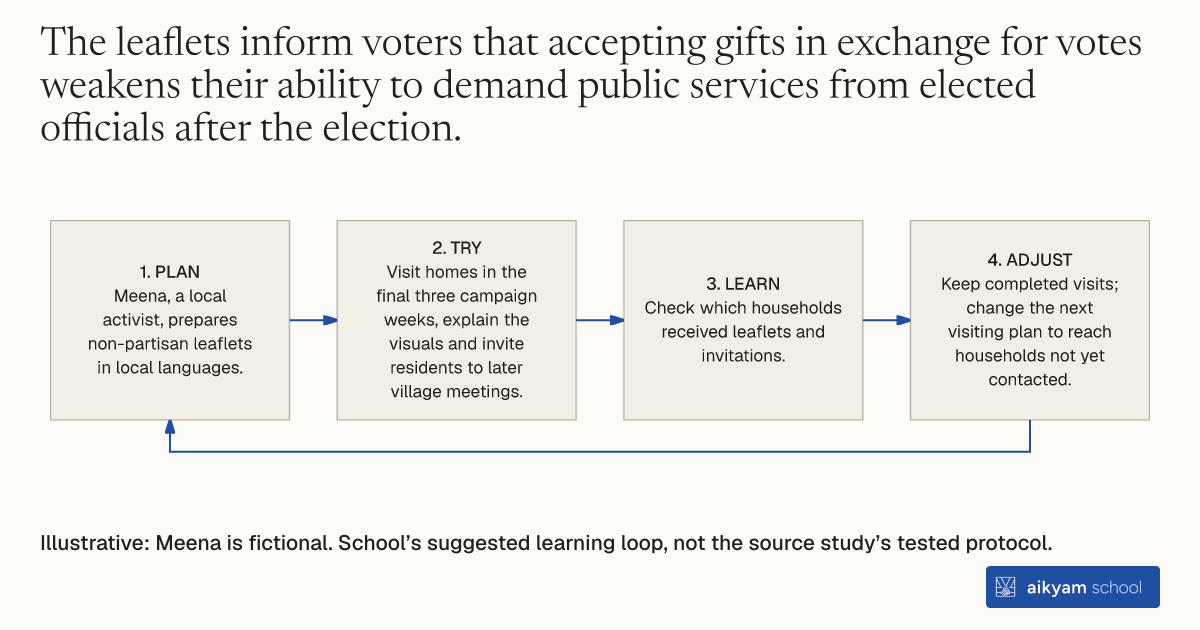
Try, learn and adjust
Check delivery of voter information
- Plan: Meena, a local activist, prepares non-partisan leaflets in local languages.
- Try: Visit homes in the final three campaign weeks, explain the visuals and invite residents to later village meetings.
- Learn: Check which households received leaflets and invitations.
- Adjust: Keep completed visits; change the next visiting plan to reach households not yet contacted.
Illustrative: Meena is fictional. School’s suggested learning loop, not the source study’s tested protocol.
See source →School’s suggested learning loop: Observe leaflet reach and invitations. This check does not isolate leaflet effects from the wider campaign.
How
When to use
In developing democracies where vote buying is widespread, politicians distribute cash and goods to influence voter choices during elections. This practice undermines political accountability and reduces the quality of public services like schools and health clinics. Delivering non-partisan educational materials directly to voters' homes helps citizens understand the long-term community costs of vote selling.
Distribute non-partisan educational leaflets directly to households through door-to-door activist visits before an election.
- Recruit local civil society activists who reside in or are well known within targeted villages.
- Print non-partisan educational leaflets in local languages explaining how vote selling leads to a loss of public service delivery.
- Dispatch activists to visit households door-to-door during the final three weeks of the election campaign.
- Hand leaflets directly to household members and explain the main visual messages.
- Invite household members to participate in upcoming village community deliberation meetings.
Why it works
This message reduces voter reciprocity by reframing vote buying as a bad deal for the community's future.
Example
In the three weeks before Uganda's 2016 general election, local activists from a civil society coalition delivered leaflets in 18 local languages to 67,374 households across 1,427 targeted villages.
About the study
Participants
28,454 registered voters surveyed across 918 parishes in 53 districts in Uganda, covering 1.2 million registered voters.
Study Design
Two-level randomized saturation design at parish and polling station levels, evaluated using post-election voter surveys, key informant interviews, and official election results.
Results
Leaflets reached an estimated 41% of households in target villages, contributing to a 1.3 percentage point increase in awareness of the negative consequences of vote buying and an 8.2 percentage point increase in village resolutions.