Try, learn and adjust
Check election-eve reminder calls
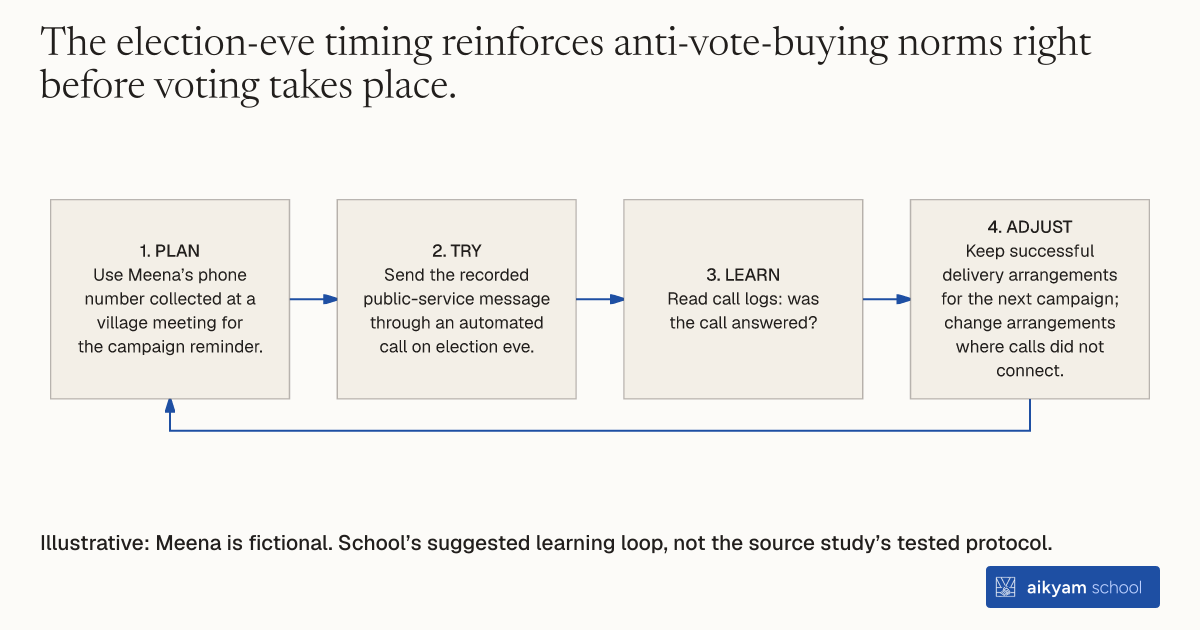
- Plan: Use Meena’s phone number collected at a village meeting for the campaign reminder.
- Try: Send the recorded public-service message through an automated call on election eve.
- Learn: Read call logs: was the call answered?
- Adjust: Keep successful delivery arrangements for the next campaign; change arrangements where calls did not connect.
Illustrative: Meena is fictional. School’s suggested learning loop, not the source study’s tested protocol.
See source →School’s suggested learning loop: Observe completed and answered calls. Answering a call does not establish a change in voting behaviour.
How
When to use
In elections where vote buying is widespread, voters often accept pre-election gifts and feel bound by reciprocity. Delivering targeted automated voice calls directly to voters on the eve of an election reinforces anti-vote-buying messages right before citizens cast their ballots. This reminder helps voters resist gift-reciprocity pressure and consider long-term community service needs.
Deliver automated voice call reminders on the eve of an election to citizens who provided phone numbers during community campaign meetings.
- Collect telephone contact numbers from citizens attending village anti-vote-buying meetings.
- Record a concise voice message explaining that selling votes undermines future community public services.
- Configure an automated telecommunications system to place calls on election eve.
- Deliver the recorded audio message to registered phone numbers.
- Record call completion statistics through automated telecommunications logs.
Why it works
The message explicitly reminds voters that politicians who buy votes will later refuse to provide public services.
Example
On February 17, 2016, the eve of Uganda's general election, an election monitoring coalition placed 32,674 automated calls to meeting participants, with 18,451 calls answered.
About the study
Participants
28,454 registered voters surveyed across 918 parishes in 53 districts in Uganda, covering 1.2 million registered voters.
Study Design
Two-level randomized saturation design at parish and polling station levels, evaluated using post-election voter surveys, key informant interviews, and official election results.
Results
Delivered as part of a campaign package that increased awareness of the negative consequences of vote buying by 1.3 percentage points and increased expectations of social sanctions for vote selling by 2.6 percentage points.