Try, learn and adjust
Check appliance rebates and realised energy use
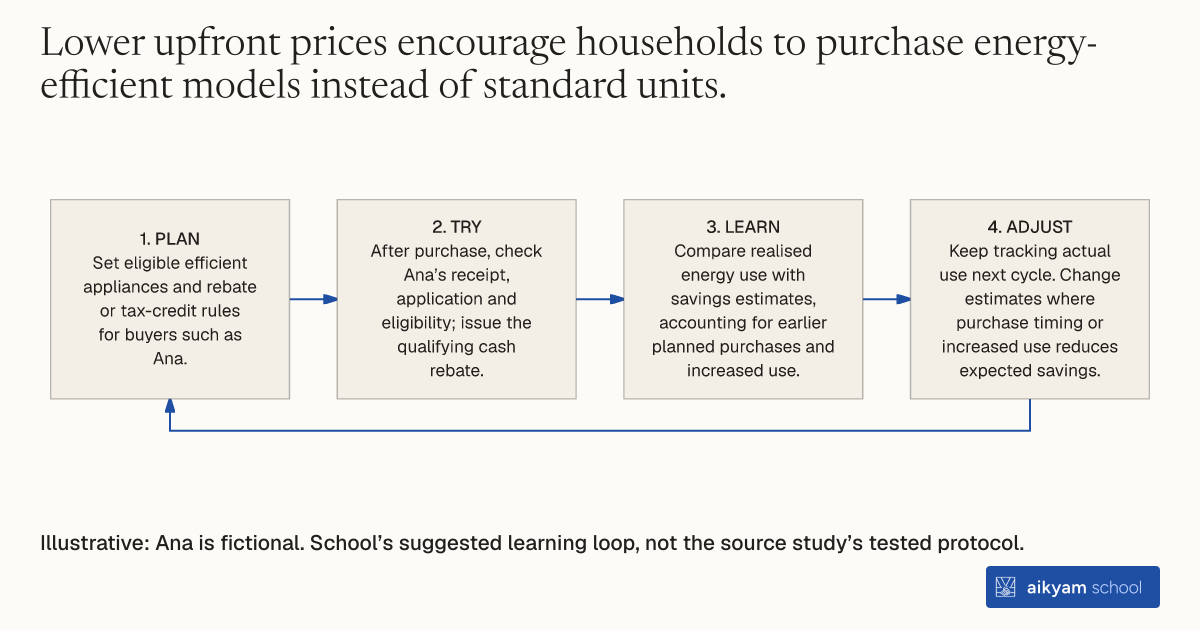
- Plan: Set eligible efficient appliances and rebate or tax-credit rules for buyers such as Ana.
- Try: After purchase, check Ana’s receipt, application and eligibility; issue the qualifying cash rebate.
- Learn: Compare realised energy use with savings estimates, accounting for earlier planned purchases and increased use.
- Adjust: Keep tracking actual use next cycle. Change estimates where purchase timing or increased use reduces expected savings.
Illustrative: Ana is fictional. School’s suggested learning loop, not the source study’s tested protocol.
See source →School’s suggested learning loop: observe receipts, payments and energy use. Efficient appliance adoption does not guarantee engineering-projected savings.
How
When to use
Municipalities face high greenhouse gas emissions from residential building energy use. Households often delay replacing older energy-inefficient appliances due to upfront purchase costs. Cash rebates and purchase subsidies lower these financial hurdles for single-family homeowners and property owners.
Offer direct rebates or tax credits to local residents buying energy-efficient appliances.
- Select eligible high-efficiency appliances including washing machines, dryers, dishwashers, refrigerators, and air conditioning units.
- Establish rebate amounts and tax credit rules for participating retail purchases.
- Require retail customers to submit purchase receipts and rebate application forms after buying qualifying units.
- Verify eligibility requirements and issue cash payments directly to qualifying buyers.
- Adjust program energy savings estimates downward to account for accelerated baseline purchases and rebound consumption.
Why it works
Financial rebates also prompt some families to replace aging appliances earlier than originally planned.
Example
Local energy efficiency programs across the United States provided rebates for high-efficiency air conditioning units, refrigerators, and washing machines. Participating households installed cleaner equipment, though some buyers merely moved up planned purchases or increased total appliance usage after installation.
About the study
Participants
Synthesis of 161 impact evaluations covering single-family homeowners, multi-family building owners, and utility customers in the United States and comparable high-income countries post-2000.
Study Design
Systematic literature review of experimental and quasi-experimental evaluations using difference-in-differences, randomized trials, and regression discontinuity designs.
Results
Appliance incentive programs generally increased adoption of efficient washing machines, dryers, and dishwashers. Efficient air conditioning rebates lowered electricity consumption among installing households, but overall savings fell below engineering projections due to consumer rebound effects and non-additionality.