Try, learn and adjust
Check housing-led energy retrofits
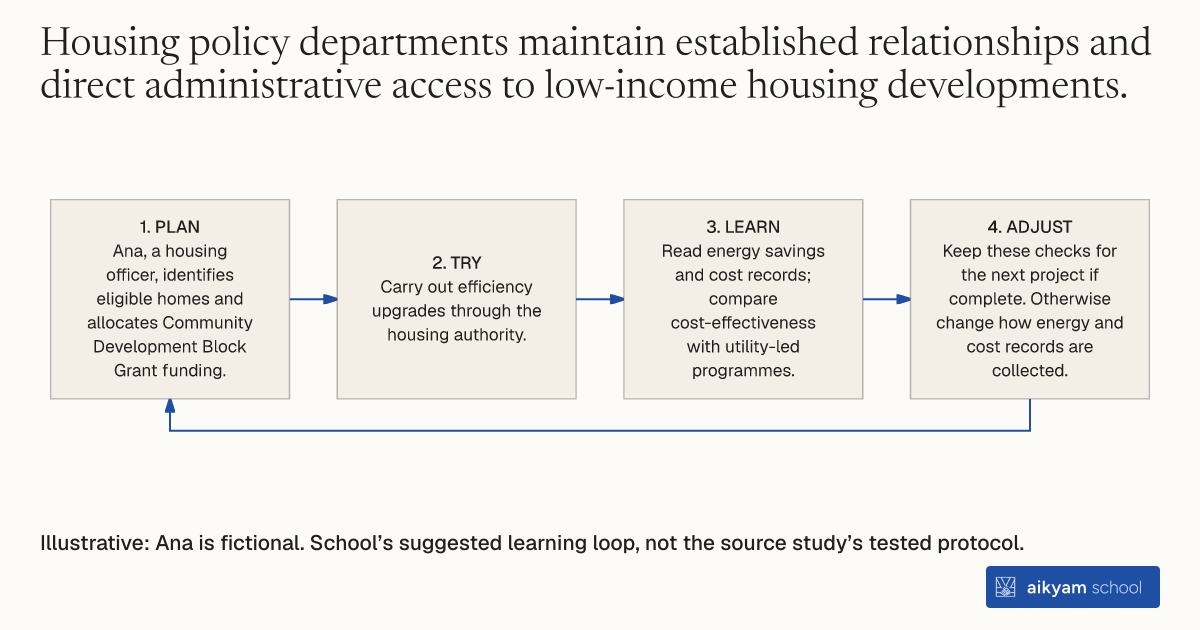
- Plan: Ana, a housing officer, identifies eligible homes and allocates Community Development Block Grant funding.
- Try: Carry out efficiency upgrades through the housing authority.
- Learn: Read energy savings and cost records; compare cost-effectiveness with utility-led programmes.
- Adjust: Keep these checks for the next project if complete. Otherwise change how energy and cost records are collected.
Illustrative: Ana is fictional. School’s suggested learning loop, not the source study’s tested protocol.
See source →School’s suggested, untested learning loop. Observe energy savings, retrofit costs and programme cost-effectiveness.
How
When to use
Traditional utility-administered low-income energy efficiency programs often struggle with cost-ineffectiveness and low participation. Housing policy departments and local housing authorities already possess direct administrative channels to low-income households. Administering building retrofits through housing agencies solves targeting and implementation barriers in low- and moderate-income communities.
Administer energy efficiency retrofits for low-income communities through local housing policy departments using Community Development Block Grants.
- Federal and municipal housing authorities allocate Community Development Block Grant funds to local housing projects.
- Housing policy staff identify eligible low- and moderate-income residential properties for building upgrades.
- Retrofit teams execute energy efficiency improvements across housing authority properties.
- Housing agency staff track energy savings and cost metrics across retrofitted developments.
- Program managers evaluate program cost-effectiveness relative to traditional utility-administered programs.
Why it works
Delivering retrofits through housing agencies avoids the high administrative overhead and targeting friction typical of energy utilities.
Example
An evaluation of Community Development Block Grant housing programs evaluated energy efficiency retrofits in low- and moderate-income communities. Administering retrofits through housing policy departments delivered cost-effective energy savings that outperformed traditional utility programs.
About the study
Participants
Low- and moderate-income residential housing communities in the United States evaluated by Asensio et al. (2024).
Study Design
Quasi-experimental evaluation of federal Community Development Block Grant energy efficiency retrofits administered by housing policy departments.
Results
Housing-administered CDBG retrofits proved highly cost-effective and achieved significant energy savings, contrasting with the relative cost-ineffectiveness of utility-led means-tested energy programs.