Try, learn and adjust
Check retrofit quality and measured energy use
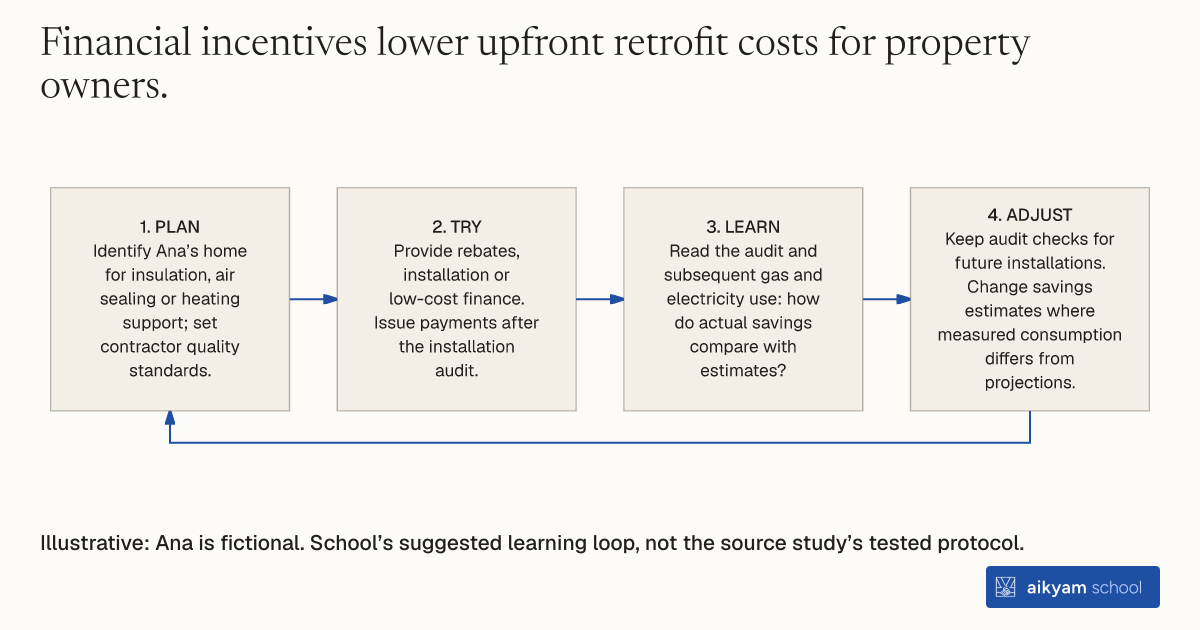
- Plan: Identify Ana’s home for insulation, air sealing or heating support; set contractor quality standards.
- Try: Provide rebates, installation or low-cost finance. Issue payments after the installation audit.
- Learn: Read the audit and subsequent gas and electricity use: how do actual savings compare with estimates?
- Adjust: Keep audit checks for future installations. Change savings estimates where measured consumption differs from projections.
Illustrative: Ana is fictional. School’s suggested learning loop, not the source study’s tested protocol.
See source →School’s suggested learning loop: observe installation quality, payments and actual energy use. Reported savings were below initial engineering estimates.
How
When to use
Residential energy use in single-family homes produces substantial greenhouse gas emissions. High upfront installation costs and uncertainties about contractor quality deter homeowners from retrofitting aging heating systems and insulation. Municipal incentive programs offer financial rebates or direct retrofits to increase household energy efficiency.
Incentivize residential weatherization and space heating upgrades to lower building energy consumption.
- Identify target residential properties, focusing on single-family homeowners and low-income households.
- Provide financial rebates, direct installation services, or low-cost financing for insulation, air sealing, and space heating equipment.
- Require participating contractors to meet quality standards during retrofit installations.
- Issue incentive payments to property owners or contractors upon audit completion.
- Track household natural gas and electricity usage after installation to measure realized energy savings.
Why it works
Upgrading home insulation and heating systems reduces thermal loss and cuts fuel required to maintain indoor temperatures.
Example
Program evaluations in Wisconsin, Michigan, and Illinois offered weatherization and heating retrofits to single-family households. Participating homes reduced their natural gas and electricity consumption, though realized energy savings were substantially smaller than initial engineering estimates.
About the study
Participants
Single-family homeowners, multi-family building owners, and utility customers across the United States, including Michigan, Wisconsin, and Illinois.
Study Design
Randomized encouragement designs, randomized controlled trials, and difference-in-differences evaluating utility billing records.
Results
Weatherization and heating incentives reduced household energy consumption. Realized savings were far less than projected due to contractor installation quality variations, low energy price visibility, and household rebound effects.