Try, learn and adjust
Check local worker selection follows the panel process
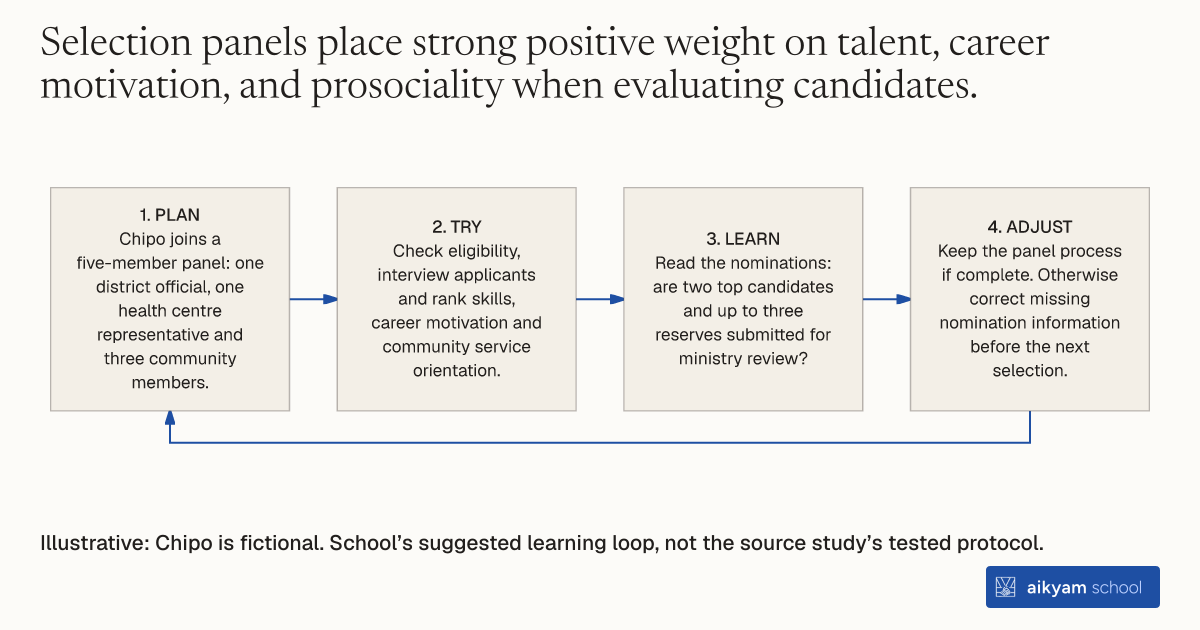
- Plan: Chipo joins a five-member panel: one district official, one health centre representative and three community members.
- Try: Check eligibility, interview applicants and rank skills, career motivation and community service orientation.
- Learn: Read the nominations: are two top candidates and up to three reserves submitted for ministry review?
- Adjust: Keep the panel process if complete. Otherwise correct missing nomination information before the next selection.
Illustrative: Chipo is fictional. School’s suggested learning loop, not the source study’s tested protocol.
See source →School’s suggested, untested learning loop. Observe panel membership, rankings and nominations; do not infer worker performance.
How
When to use
Public organizations need to select effective frontline service providers from local applicant pools without sacrificing prosocial dedication or technical qualifications. Standard centralized hiring often lacks local context or fails to screen for candidate motivation. Establishing multi-stakeholder community panels that evaluate candidate skills and public service orientation identifies top-tier talent while preserving community alignment.
Establish local multi-stakeholder selection committees combining public health officials and community members to shortlist frontline service candidates from applicant pools.
- District health offices assemble five-member selection panels comprising one district health official, one health center staff representative, and three local neighborhood health committee members.
- Selection panels review candidate application packages to verify basic eligibility including completed secondary education and local residence.
- Panel members conduct face-to-face interviews to observe applicant skills, career ambition, and community service preferences.
- Selection committees rank applicants based on cognitive exam performance, career motivation, and prosocial orientation.
- Panels nominate two top candidates for final appointment along with up to three alternate reserves for central health ministry review.
Why it works
When career incentives attract higher-ability applicants into the pool, panels select from the top of the ability distribution where candidates possess both higher technical skills and strong prosocial motivation.
Example
Ministry of Health selection panels evaluated 1,585 interviewed applicants across 48 rural districts in Zambia to hire Community Health Assistants. The 161 five-member panels nominated 334 top candidates and 413 reserves. Selected candidates achieved average O-level exam scores of 27.2 in career treatment districts and 25.6 in control districts—both exceeding the 90th percentile of random applicant draws (24.9 and 23.1)—while maintaining high prosociality scores of 2.55.
About the study
Participants
1,585 interviewed candidates evaluated by 161 five-member panels across 48 rural districts in Zambia, resulting in 334 nominated top candidates (average age 26, 30 percent female).
Study Design
OLS regression analysis evaluating selection probabilities based on candidate skill rank, prosociality, career ambition, and social connections across treatment and control districts.
Results
Ranking in the top 3 for skills increased candidate selection probability by 19.1 percentage points in treatment and 15.3 percentage points in control (p=0.43 for difference). Prosociality in the top 3 increased selection probability by 2.5 percentage points in treatment and 6.6 percentage points in control (p=0.21 for difference). Local political or health facility connections had no statistically significant effect on selection probability (p=0.82 and p=0.62).