Try, learn and adjust
Check digital land applications reach final review
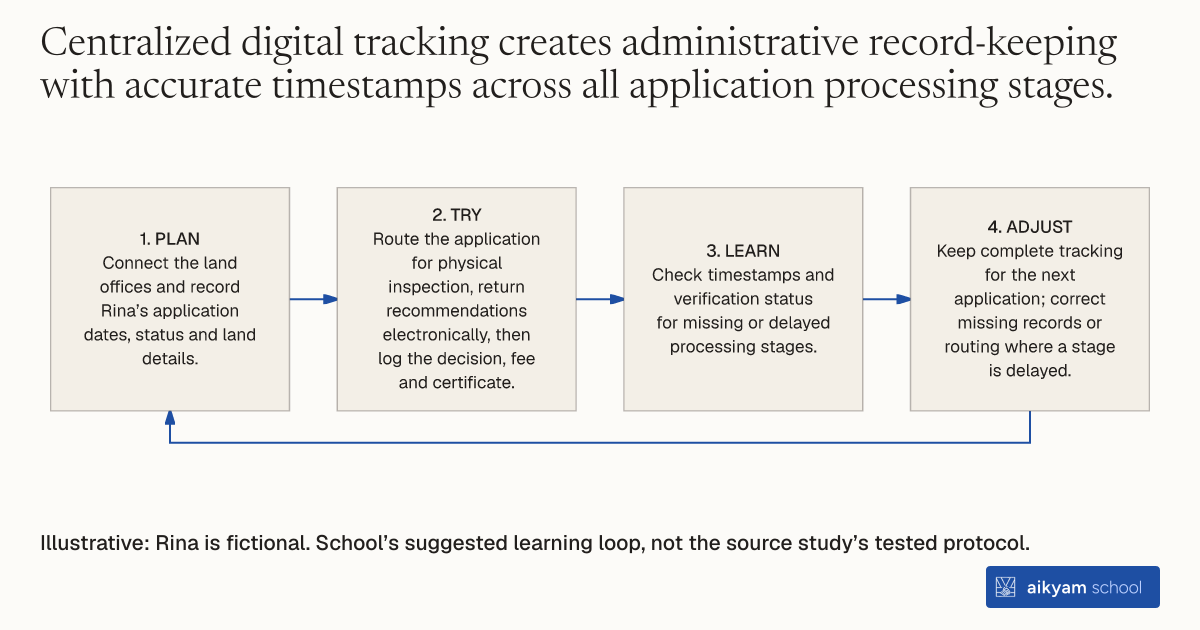
- Plan: Connect the land offices and record Rina’s application dates, status and land details.
- Try: Route the application for physical inspection, return recommendations electronically, then log the decision, fee and certificate.
- Learn: Check timestamps and verification status for missing or delayed processing stages.
- Adjust: Keep complete tracking for the next application; correct missing records or routing where a stage is delayed.
Illustrative: Rina is fictional. School’s suggested learning loop, not the source study’s tested protocol.
See source →Observe application status, processing times, decisions, the BDT 1,150 fee and certificate issue. School suggests this learning loop; it was not tested by the source.
How
When to use
Public land registries in low- and middle-income countries face severe processing delays, causing widespread land disputes. Paper-based filing lacks centralized monitoring and operational visibility across administrative tiers. This method provides digital submission, tracking, and workflow management for civil service land record changes.
Digitize land record modification workflows through a centralized e-governance tracking system across subdistrict land offices.
- Install central web-based e-governance software at subdistrict land offices and link local land offices to the network.
- Receive land record mutation applications online or via computer terminals at subdistrict land offices.
- Record application start dates, verification status, and land details into a central digital database.
- Route applications electronically to local Union Parishad land office assistants for physical land inspection.
- Transmit local verification recommendations electronically back to the Assistant Commissioner Land for final review.
- Log approval decisions, collect official BDT 1,150 fees, and issue new record of rights khatian certificates.
Why it works
This eliminates paper-based workflow bottlenecks and provides the underlying data necessary for systematic performance monitoring.
Example
In Bangladesh, the government deployed an e-governance system across 311 subdistrict land offices serving 97 million people, tracking over 1.03 million land mutation applications.
About the study
Participants
311 subdistrict land offices in Bangladesh serving approximately 97 million people, tracking 1,034,688 applications.
Study Design
Large-scale e-governance administrative data collection tracking all land record change applications from August 2018 to December 2020.
Results
Tracked 1,034,688 applications across 311 land offices, establishing a baseline control performance where 56% of applications were processed within 45 working days with an average processing time of 64 working days.