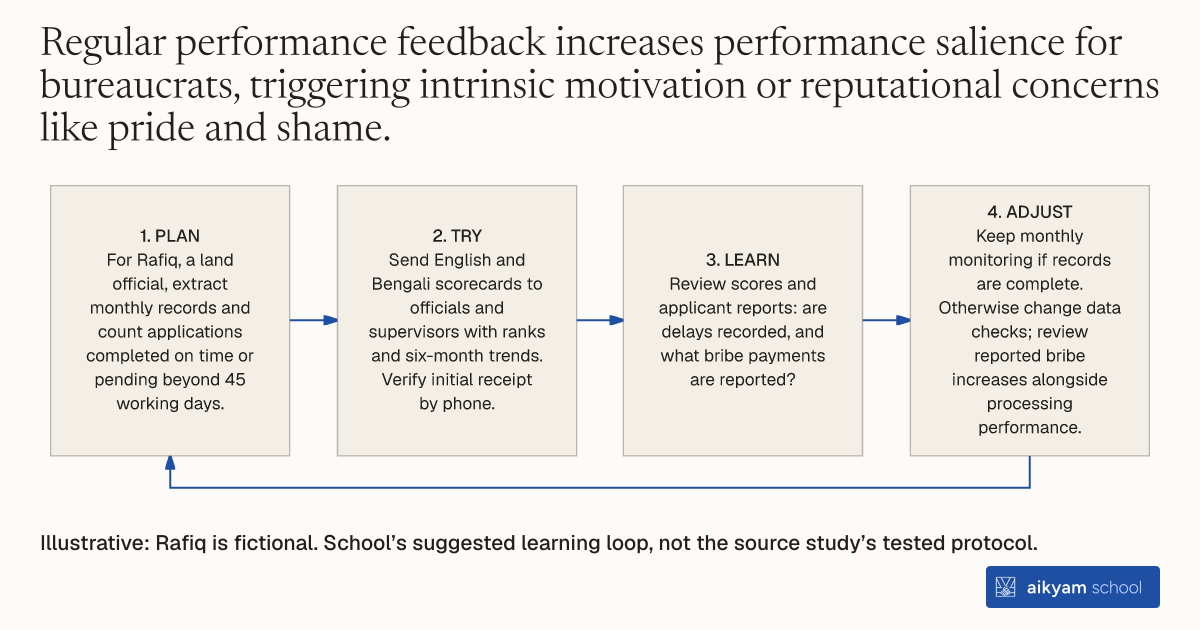
Try, learn and adjust
Check scorecards reveal processing delays
- Plan: For Rafiq, a land official, extract monthly records and count applications completed on time or pending beyond 45 working days.
- Try: Send English and Bengali scorecards to officials and supervisors with ranks and six-month trends. Verify initial receipt by phone.
- Learn: Review scores and applicant reports: are delays recorded, and what bribe payments are reported?
- Adjust: Keep monthly monitoring if records are complete. Otherwise change data checks; review reported bribe increases alongside processing performance.
Illustrative: Rafiq is fictional. School’s suggested learning loop, not the source study’s tested protocol.
See source →School's suggested, untested loop: observe processing delays, receipt and bribe reports; faster processing does not establish less corruption.
How
When to use
Public bureaucracies face slow public service processing times and delays. Junior officials and supervisors lack clear periodic information on application bottlenecks. This method helps government civil service agencies track and speed up service delivery.
Send monthly performance scorecards measuring application delays to junior bureaucrats and their direct supervisors using e-governance administrative data.
- Extract monthly application tracking data from the central e-governance system for each subdistrict land office.
- Calculate the monthly number of applications processed within the 45-working-day government limit for each bureaucrat.
- Calculate the monthly number of applications pending beyond the 45-working-day time limit for each bureaucrat.
- Calculate national percentile rankings for both performance indicators relative to all participating subdistrict land offices.
- Print English and Bengali scorecard sheets displaying absolute counts, percentile rankings, six-month workload trends, and visual performance icons.
- Deliver monthly printed scorecards by courier to the subdistrict Assistant Commissioner Land, Upazila Nirbahi Officer, and Deputy Commissioner.
- Conduct follow-up phone calls after the initial dispatch to verify receipt and clarify indicator metrics.
Why it works
Detailed monthly reports also allow direct supervisors to monitor processing bottlenecks and incorporate performance into annual confidential evaluation reports.
Example
In Bangladesh, 155 subdistrict land offices received monthly scorecards for 16 months measuring delays in processing land record mutation applications. Underperforming offices increased on-time delivery while high-performing bureaucrats experienced an increase in bribe payments of BDT 2,069.
About the study
Participants
311 subdistrict land offices in Bangladesh serving approximately 97 million people, analyzing 1,034,688 administrative applications and survey data from 2,869 applicants.
Study Design
Cluster-randomized controlled trial conducted over 16 months across two implementation waves, comparing scorecard treatment land offices against control land offices using e-governance administrative records and applicant phone surveys.
Results
Scorecards increased on-time application processing within 45 working days by 6 percentage points (an 11% increase) and reduced overall processing times by 13% (12.6 log points), but increased typical bribe payments by BDT 2,069 (38%) in baseline overperforming offices.