Research procedure
Assess skills at apprenticeship completion
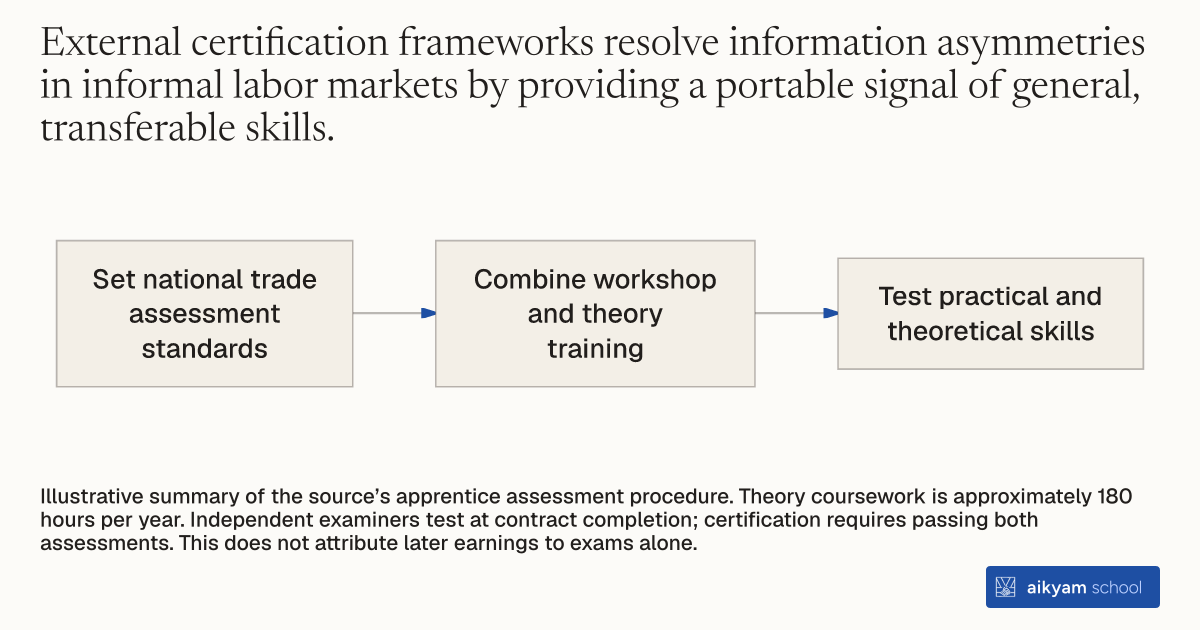
- Set national trade assessment standards
- Combine workshop and theory training
- Test practical and theoretical skills
Illustrative summary of the source’s apprentice assessment procedure. Theory coursework is approximately 180 hours per year. Independent examiners test at contract completion; certification requires passing both assessments. This does not attribute later earnings to exams alone.
See source →How
When to use
Informal apprenticeships in developing countries often lack objective testing, leaving employers uncertain about an applicant's real skills. Public vocational training programs need a reliable way to verify that trainees have acquired transferable, high-quality trade capabilities. Evaluating trainees through standardized external practical and theoretical exams provides an objective measure of skill acquisition and generates recognizable credentials for the labor market.
Evaluate dual apprentice skill acquisition through standardized external practical and theoretical examinations upon program completion.
- Establish national competency benchmarks and exam rubrics for each targeted vocational trade through the national training authority.
- Require dual apprentices to complete approximately 180 hours of theoretical coursework per year at local vocational institutes alongside practical workshop training.
- Schedule end-of-program practical trade tests and written theoretical exams administered by independent vocational examiners upon contract completion.
- Issue formal skill certifications to candidates who pass both the practical and theoretical assessments.
Why it works
This credential allows certified workers to command higher earnings and move across employers without relying solely on informal employer referrals.
Example
The national training agency in Côte d'Ivoire administered standardized skill assessments to dual apprentices across 7 urban localities at the end of their 12- to 24-month contracts, resulting in 15.1 percentage points more treated youth earning formal training certification compared to 9.5 percent in the control group.
About the study
Participants
1,670 youth respondents tracked at 4-year endline follow-up (87 percent male, average age 20.7 years) across 7 urban localities in Côte d'Ivoire.
Study Design
Longitudinal randomized controlled trial evaluating end-of-program certification rates, worker task complexity indices, and 4-year labor market earnings.
Results
Dual apprenticeship increased formal skill certification rates by 15.1 percentage points (p < 0.0001) over the 9.5 percent control group mean, increased non-routine analytical task involvement by 0.243 standard deviations (p < 0.0001), and raised total monthly earnings by 15 percent (9,394 FCFA/month, p = 0.0169) four years after baseline.