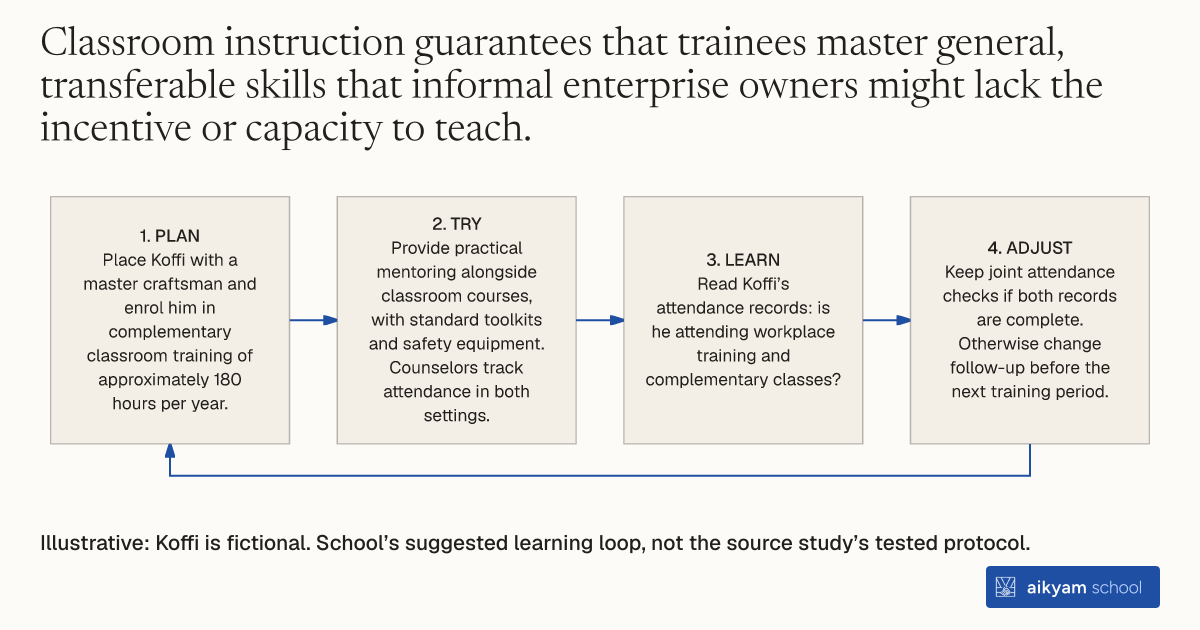
Try, learn and adjust
Check both parts of dual training
- Plan: Place Koffi with a master craftsman and enrol him in complementary classroom training of approximately 180 hours per year.
- Try: Provide practical mentoring alongside classroom courses, with standard toolkits and safety equipment. Counselors track attendance in both settings.
- Learn: Read Koffi’s attendance records: is he attending workplace training and complementary classes?
- Adjust: Keep joint attendance checks if both records are complete. Otherwise change follow-up before the next training period.
Illustrative: Koffi is fictional. School’s suggested learning loop, not the source study’s tested protocol.
See source →School’s suggested, untested loop: observe attendance in concurrent workplace and classroom learning; this does not isolate either component’s effects.
How
When to use
Traditional informal apprenticeships in developing countries rely heavily on practical workplace tasks, leaving trainees without general theoretical knowledge or transferable qualifications. Combining practical mentoring at local microenterprises with structured classroom courses in vocational centers equips low-skilled youth with both firm-specific and general skills. This dual approach ensures comprehensive trade learning without sacrificing practical work experience.
Combine practical microenterprise apprenticeship with structured theoretical classroom instruction through local vocational training centers.
- Define essential trade curricula and general technical competencies for target occupations through national vocational training authorities.
- Place enrolled trainees in informal host enterprises to receive daily practical mentoring under experienced master craftsmen.
- Enroll trainees in local vocational training institutions to complete approximately 180 hours per year of complementary theoretical coursework.
- Supply trainees with standardized work toolkits and safety equipment to support practical learning during workshop placements.
- Deploy vocational counselors to track trainee attendance across both workplace assignments and classroom sessions.
Why it works
Simultaneously, practical workplace mentoring ensures apprentices gain real-world work habits and firm-specific soft skills.
Example
In Côte d'Ivoire, the national training agency (AGEFOP) implemented dual apprenticeships across 7 urban localities, combining daily microenterprise training under master craftsmen with 180 annual hours of classroom instruction in vocational centers for 911 selected youth.
About the study
Participants
1,842 eligible youth applicants (911 treatment, 921 control, 87 percent male, average age 20.7 years) across 7 urban localities in Côte d'Ivoire.
Study Design
Double-sided randomized controlled trial comparing long-term human capital investments, skill indices, and labor market earnings 4 years after baseline.
Results
Dual training increased total training duration by 10.83 months over a control mean of 2.93 months (p < 0.0001), raised non-routine analytical task performance by 0.243 standard deviations (p < 0.0001), reduced overall routine task intensity by 0.213 standard deviations (p = 0.008), and increased medium-term total earnings by 15 percent (p = 0.0169).