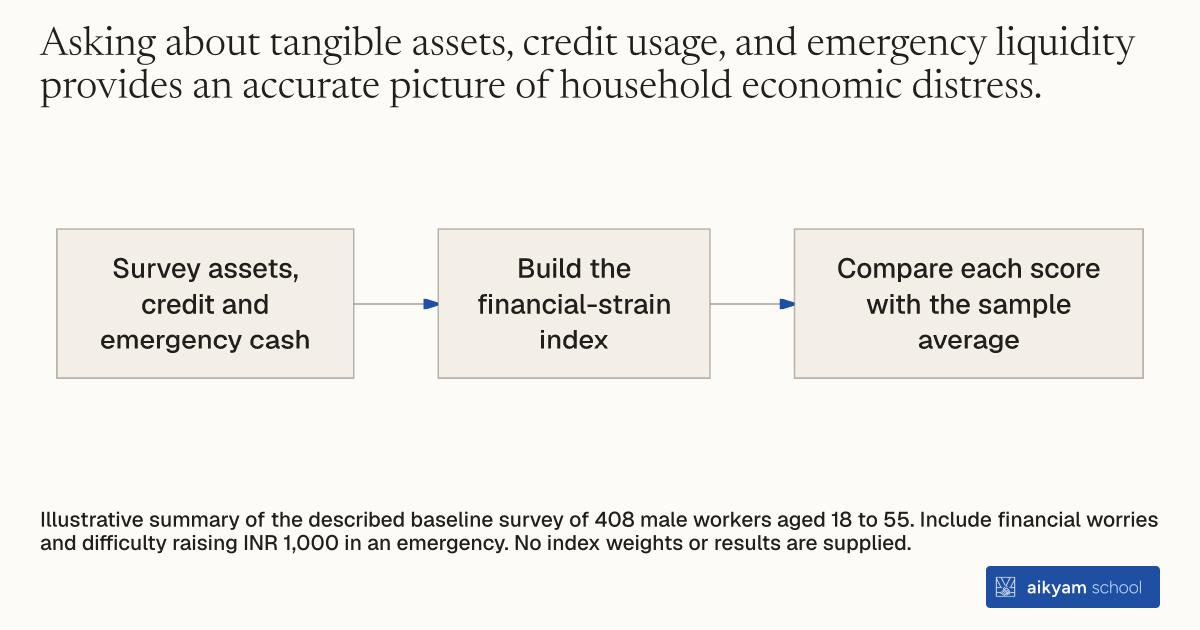
Research steps
Measure workers’ financial strain before work
- Survey assets, credit and emergency cash
- Build the financial-strain index
- Compare each score with the sample average
Illustrative summary of the described baseline survey of 408 male workers aged 18 to 55. Include financial worries and difficulty raising INR 1,000 in an emergency. No index weights or results are supplied.
See source →How
When to use
Low-income wage laborers face varying levels of financial anxiety that affect their work performance. Evaluators need to identify which workers suffer from high financial distress before designing targeted relief interventions. Assessing household financial strain through survey indicators establishes a baseline measure of economic hardship.
Evaluate individual worker financial distress using a multi-indicator baseline survey index before starting work programs.
- Administer a baseline survey to incoming wage laborers prior to their first workday.
- Ask survey questions regarding land ownership, house quality, credit usage for daily goods, and emergency cash access.
- Include specific financial worry questions about difficulty producing INR 1,000 (\$15.43) in emergencies and daily thoughts about money while working.
- Calculate a composite financial strain index score for each respondent based on asset and credit answers.
- Classify workers into high financial strain and lower financial strain groups relative to the sample average.
Why it works
Calculating a composite index reveals which individuals suffer from mental worry that harms job performance.
Example
Researchers surveyed 408 workers in Odisha, India, finding 68 percent could not raise INR 1,000 (\$15.43) in an emergency and 70 percent were very worried about future finances.
About the study
Participants
408 male wage laborers aged 18–55 across 47 villages in Odisha, India.
Study Design
Baseline survey evaluation compiling a financial strain index based on land ownership, house quality, credit use for food, and emergency cash access prior to a 12-day contract.
Results
The index identified that 68 percent of workers faced difficulty raising INR 1,000 (\$15.43) in emergencies, 70 percent were very worried about future finances, and 83 percent thought about finances while working. Workers with above-average strain produced 0.5 additional plates per hour after early pay, while lower-strain workers saw no significant change.