Try, learn and adjust
Check self-reported steps against device records
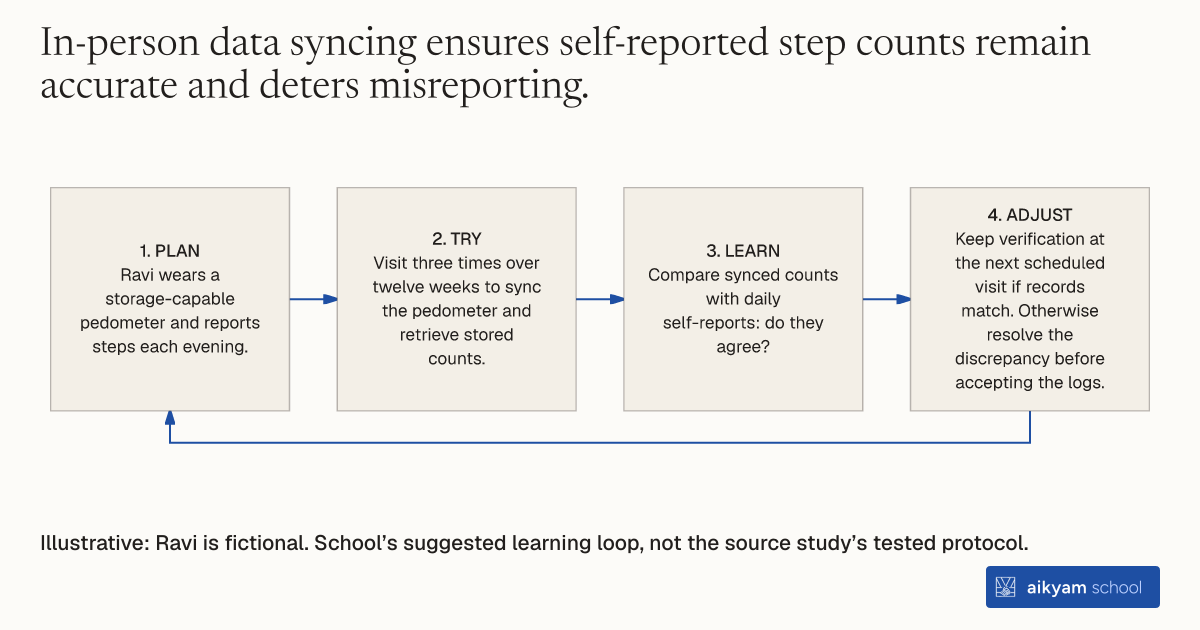
- Plan: Ravi wears a storage-capable pedometer and reports steps each evening.
- Try: Visit three times over twelve weeks to sync the pedometer and retrieve stored counts.
- Learn: Compare synced counts with daily self-reports: do they agree?
- Adjust: Keep verification at the next scheduled visit if records match. Otherwise resolve the discrepancy before accepting the logs.
Illustrative: Ravi is fictional. School’s suggested learning loop, not the source study’s tested protocol.
See source →School’s suggested, untested learning loop. Observe device records and self-reported steps at the three scheduled visits; do not add extra study visits.
How
When to use
Health programs utilizing self-reported tracking data need a reliable mechanism to verify compliance and maintain data accuracy. Automated or self-reported data can suffer from misreporting or technical errors over extended intervention periods. Periodic in-person visits to sync tracking devices verify self-reports against objective step records.
Conduct periodic field visits to participants to extract and verify stored device data against daily self-reported logs.
- Distribute physical pedometers capable of internal step storage to all program participants.
- Instruct participants to wear the pedometer daily and log their step totals each evening.
- Schedule field staff to visit participants three times across the twelve-week intervention.
- Sync each participant's pedometer hardware during the visit to retrieve stored step records.
- Cross-check the synced step data against daily self-reported logs to ensure accurate data verification.
Why it works
Periodic contact with field staff also maintains hardware functionality and participant engagement.
Example
In Coimbatore, India, researchers visited 3,192 participants three times during the twelve-week program to sync their pedometers and verify self-reported step counts.
About the study
Participants
3,192 adults in Coimbatore, India, averaging 49 years old, where 67 percent had doctor-diagnosed diabetes, 82 percent had elevated HbA1c, 49 percent had hypertension, and 61 percent had obesity.
Study Design
A randomized controlled trial evaluating physical activity incentives and step-monitoring contracts among recruited adults across eight intervention and comparison groups over twelve weeks.
Results
Periodic in-person pedometer syncing verified step data across 3,192 participants, supporting findings that incentive contracts increased target compliance by 20 percentage points and daily steps by 1,266.