Research costing
Compare mental health treatment value
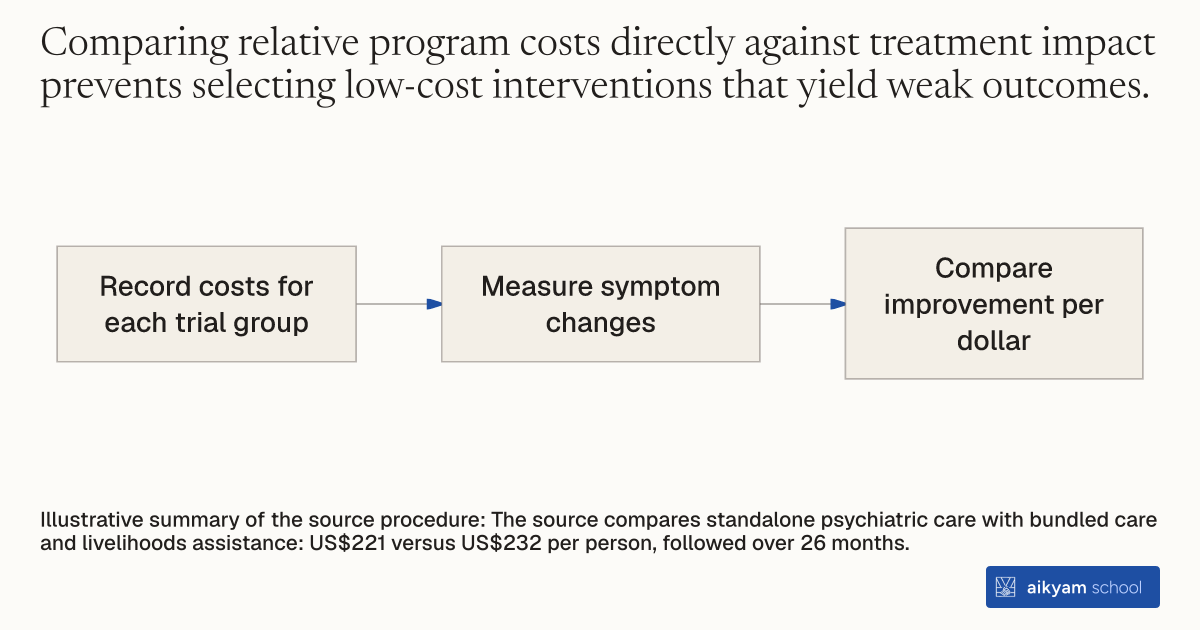
- Record costs for each trial group
- Measure symptom changes
- Compare improvement per dollar
Illustrative summary of the source procedure: The source compares standalone psychiatric care with bundled care and livelihoods assistance: US$221 versus US$232 per person, followed over 26 months.
See source →How
When to use
In low-income settings, health and economic interventions compete for limited development funding. Decision makers need to compare total program expenses against treatment performance across standalone and bundled programs. Accounting for individual unit costs and relative efficacy identifies the most cost-effective mental health delivery strategy.
Calculate unit cost per participant and divide treatment efficacy by expense to compare intervention cost-effectiveness.
- Financial officers track total implementation expenditures across each program arm.
- Analysts calculate the unit cost per individual for standalone psychiatric care and bundled interventions.
- Evaluators measure symptom reduction standard deviation changes across each study cohort.
- Program accountants calculate the ratio of mental health improvement per dollar spent.
- Decision makers compare cost-effectiveness ratios to select the optimal intervention package.
Why it works
Unit cost accounting reveals when small additions in expenditure yield disproportionately larger therapeutic gains.
Example
Evaluators calculated implementation costs across trial arms in villages near Bangalore, India, finding bundled psychiatric care and livelihoods assistance cost US\$232 per individual compared to US\$221 for standalone psychiatric care.
About the study
Participants
1,000 adults with mild or moderate depression symptoms (86 percent women) across 506 peri-urban villages near Bangalore, India.
Study Design
Cost-effectiveness analysis integrated into a four-arm randomized evaluation, comparing per-participant costs and standard deviation reductions in depression severity across treatment cohorts over 26 months.
Results
Bundled psychiatric care and livelihoods assistance was 3.5 times more effective and only 5 percent more expensive than standalone psychiatric care (US\$232 versus US\$221 per individual), making the bundled approach the most cost-effective intervention.