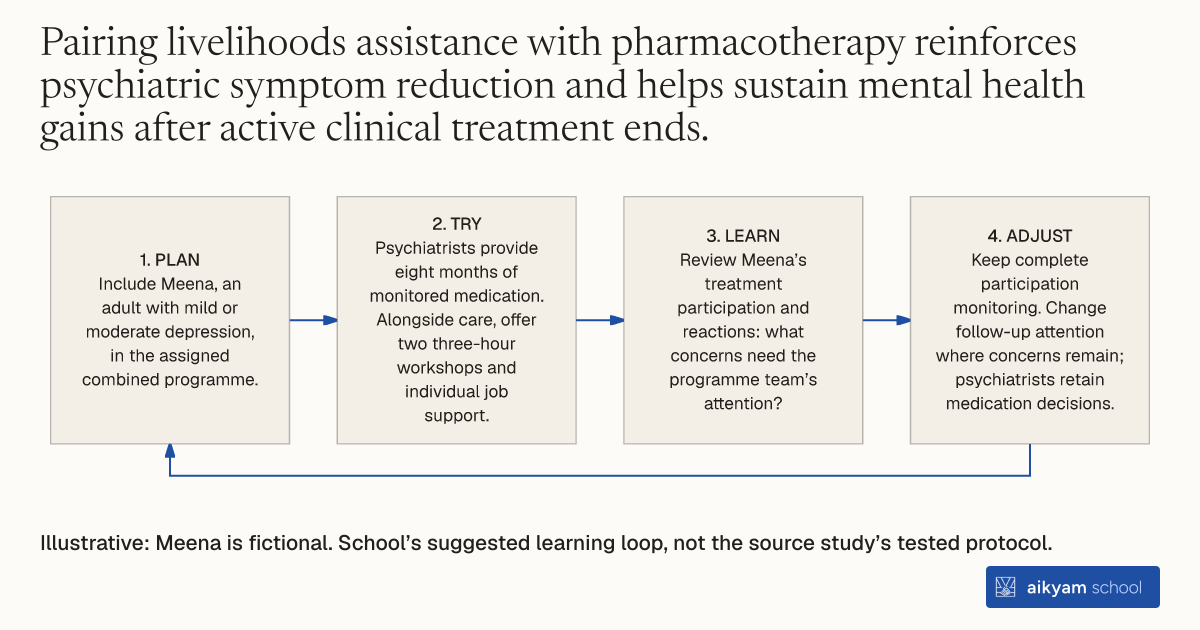
Try, learn and adjust
Check participation in combined care and work support
- Plan: Include Meena, an adult with mild or moderate depression, in the assigned combined programme.
- Try: Psychiatrists provide eight months of monitored medication. Alongside care, offer two three-hour workshops and individual job support.
- Learn: Review Meena’s treatment participation and reactions: what concerns need the programme team’s attention?
- Adjust: Keep complete participation monitoring. Change follow-up attention where concerns remain; psychiatrists retain medication decisions.
Illustrative: Meena is fictional. School’s suggested learning loop, not the source study’s tested protocol.
See source →School’s suggested, untested loop. Observe treatment participation and reactions; this is not a tested clinical protocol or evidence of individual recovery.
How
When to use
In low-income countries, single-channel mental health interventions or economic assistance programs alone often fail to sustain long-term psychological recovery or overcome productivity barriers. Combining clinical psychiatric care with structured livelihoods counseling simultaneously addresses psychiatric illness and workplace obstacles for vulnerable adults with depression.
Combine personalized pharmacotherapy with group workshops and individual job counseling for low-income adults with mild or moderate depression.
- Psychiatrists evaluate patients and prescribe personalized antidepressant medications with monthly dosage monitoring over eight months.
- Program facilitators conduct two three-hour group workshops to discuss workplace challenges and income generation strategies.
- Counselors deliver personalized job placement support through one-on-one sessions.
- Program staff monitor patient reactions and treatment participation throughout the combined intervention period.
Why it works
The dual approach addresses both psychological distress and workplace hurdles in low-income settings.
Example
Researchers and GASS delivered bundled psychiatric care and livelihoods assistance (PC/LA) to 195 adults with mild or moderate depression across peri-urban villages near Bangalore, India, combining eight months of personalized pharmacotherapy with group workshops and job placement counseling.
About the study
Participants
195 adults with mild or moderate depression symptoms (86 percent women) across peri-urban villages near Bangalore, India.
Study Design
Four-arm randomized evaluation testing combined psychiatric care and livelihoods assistance against standalone interventions and a comparison group across five survey waves over 26 months.
Results
Combined PC/LA reduced depression symptoms by 0.26 standard deviations and sustained reductions after program completion, proving 3.5 times more effective while costing only 5 percent more than standalone psychiatric care (US\$232 versus US\$221 per individual).