Adaptive research
Adjust messages across ten rounds
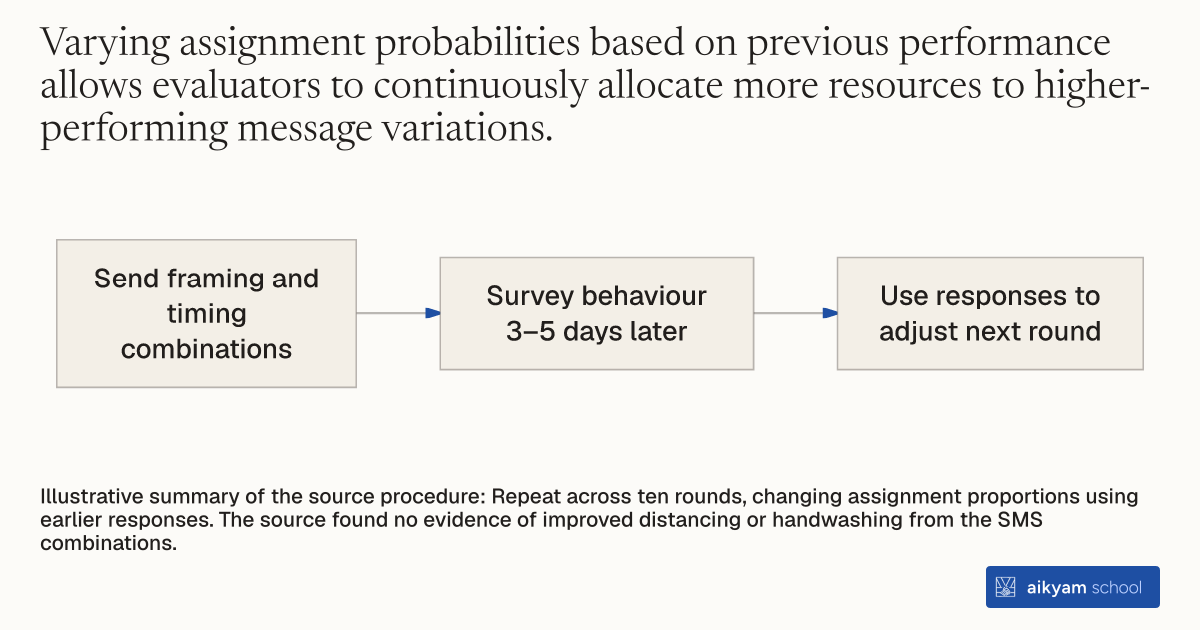
- Send framing and timing combinations
- Survey behaviour 3–5 days later
- Use responses to adjust next round
Illustrative summary of the source procedure: Repeat across ten rounds, changing assignment proportions using earlier responses. The source found no evidence of improved distancing or handwashing from the SMS combinations.
See source →How
When to use
In public health campaigns with multiple message options, organizations do not know in advance which wording or timing will work best. Running static trials risks sending underperforming messages to large numbers of recipients. An adaptive trial design allows program evaluators to dynamically shift delivery toward the most effective message options over multiple rounds.
Optimize text message delivery dynamically across multiple trial rounds using participant survey feedback from earlier rounds.
- Program evaluators divide the overall study sample into ten distinct sequential implementation rounds.
- Researchers send initial combinations of message framings and delivery timings to participants in the first round.
- Surveyors conduct phone interviews three to five days after message delivery to measure behavioral outcomes.
- Data analysts evaluate which framing and timing combinations generated higher reported rates of social distancing and handwashing.
- Program administrators adjust the proportion of messages assigned to each framing and timing combination in the subsequent round, favoring options that proved more effective.
- Researchers repeat this feedback cycle across nine additional rounds for a total of ten adaptive trial iterations.
Example
Researchers in Saran, Bihar tested SMS messaging across 3,964 households in ten adaptive rounds, adjusting assignment probabilities for five framings and two timing schedules based on survey results from prior rounds.
About the study
Participants
3,964 households in 15 blocks of Saran, Bihar, India.
Study Design
Adaptive randomized controlled trial conducted over ten rounds, dynamically reallocating message framing and timing proportions based on participant feedback from preceding rounds.
Results
The study found no evidence that SMS messages improved social distancing or handwashing behaviors across any round or message combination in the adaptive trial.