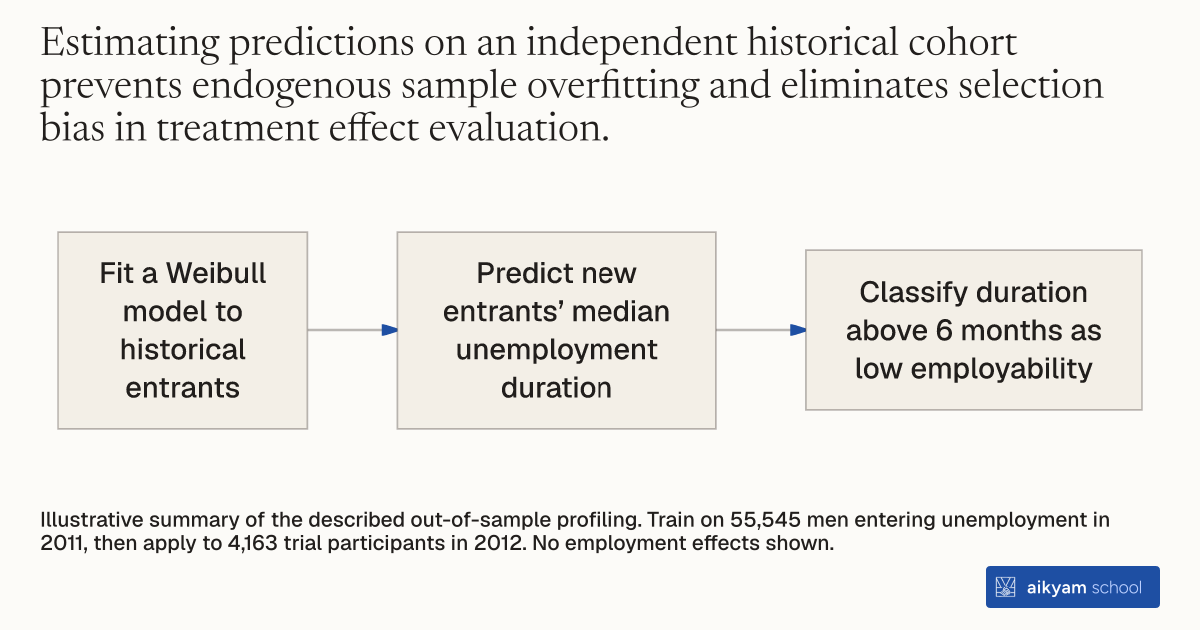
Research steps
Predict unemployment duration
- Fit a Weibull model to historical entrants
- Predict new entrants’ median unemployment duration
- Classify duration above 6 months as low employability
Illustrative summary of the described out-of-sample profiling. Train on 55,545 men entering unemployment in 2011, then apply to 4,163 trial participants in 2012. No employment effects shown.
See source →How
When to use
Active labor market programs affect job seekers differently depending on their labor market prospects. Classifying participants using in-sample trial data causes overfitting and statistical bias in treatment effect estimates. Estimating a duration model on historical pre-experimental data classifies newly registered job seekers into employability groups without contaminating experimental results.
Classify newly registered job seekers into employability groups using a hazard model trained on historical pre-experimental inflow data.
- Collect administrative register data for a historical inflow cohort of unemployed workers from the year preceding the intervention.
- Estimate a Weibull proportional hazard duration model using individual demographic variables, past wage history, and prior unemployment spells.
- Calculate predicted median unemployment durations for newly registered job seekers entering the program.
- Set a duration threshold, such as six months, to divide job seekers into high-employability and low-employability groups.
- Assign target interventions specifically to the low-employability group based on their predicted durations.
Why it works
This allows policy makers to identify subgroups that benefit most from active interventions without altering experimental baseline balance.
Example
Researchers used administrative records of 55,545 German men who entered unemployment in 2011 to build a Weibull duration model. They applied this model to 4,163 trial participants in 2012, placing 1,688 workers into a high-employability group and 2,475 workers into a low-employability group with predicted median durations above six months.
About the study
Participants
55,545 male UI entrants from 2011 used to classify 4,163 male job seekers aged 25 to 64 in Germany.
Study Design
Out-of-sample Weibull Proportional Hazard duration model estimated on historical pre-experimental register data to predict individual median unemployment durations.
Results
The model classified 40% of trial participants as high employability and 60% as low employability, revealing that early integration agreements increased 1-year re-employment from 45% to 53% for low-employability workers while having no effect on high-employability workers.