Research procedure
Check baseline balance before intervention
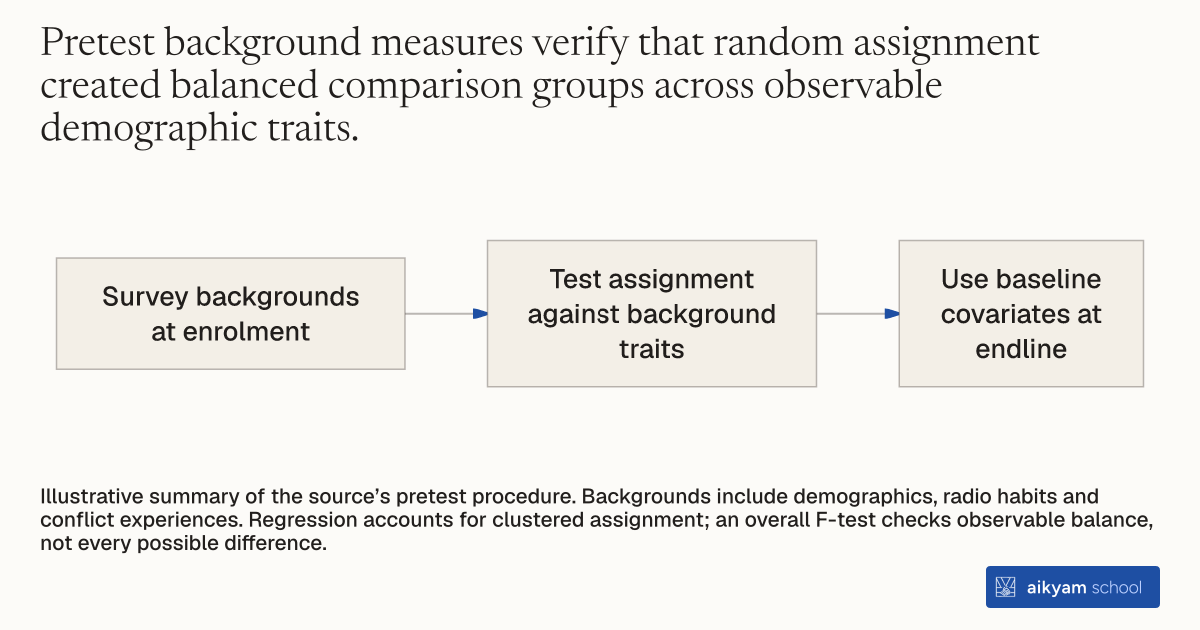
- Survey backgrounds at enrolment
- Test assignment against background traits
- Use baseline covariates at endline
Illustrative summary of the source’s pretest procedure. Backgrounds include demographics, radio habits and conflict experiences. Regression accounts for clustered assignment; an overall F-test checks observable balance, not every possible difference.
See source →How
When to use
Evaluating field interventions risks unobserved baseline differences between treatment and control clusters. Without pre-intervention background data, researchers cannot verify whether experimental groups were properly balanced. Brief baseline surveys collect participant demographic covariates and confirm that group allocation succeeded before treatment begins.
Administer a brief individual pretest survey upon enrollment to collect demographic background data and verify experimental balance across study arms.
- Administer a short structured questionnaire immediately after a participant agrees to join the study.
- Record participant background traits including age, sex, education level, radio ownership, and radio listening habits.
- Collect historical and war trauma exposure variables, including displacement history, loss of family members during conflict, and family imprisonment status.
- Regress the binary treatment assignment variable on all participant background characteristics, accounting for clustered random assignment.
- Perform an overall F-test on the regression model to verify that participant attributes show no statistically significant association with treatment assignment.
- Use the baseline background variables as regression covariates in endline outcome analyses to reduce error variance.
Why it works
Including baseline covariates in posttest statistical models reduces disturbance variance and increases statistical power.
Example
In post-genocide Rwanda, four research assistants conducted individual pretest interviews with 556 sampled participants across 14 community clusters, gathering data on demographic traits, radio habits, and genocide experiences before the year-long radio intervention began.
About the study
Participants
556 participants across 14 community clusters in Rwanda (50% male, average age 38.9 years, 79% farmers, 53% radio owners, 69% lost a relative in 1994).
Study Design
Cluster-randomized trial baseline check where researchers administered pretest questionnaires upon enrollment, regressed treatment assignment on background attributes with cluster adjustment, and conducted an overall F-test for balance.
Results
Baseline data confirmed experimental balance across conditions, yielding an insignificant overall F-test (F = 0.73, p = .65) that proved no unexpected association between participant attributes and treatment assignment.