Try, learn and adjust
Check community benefit reallocation
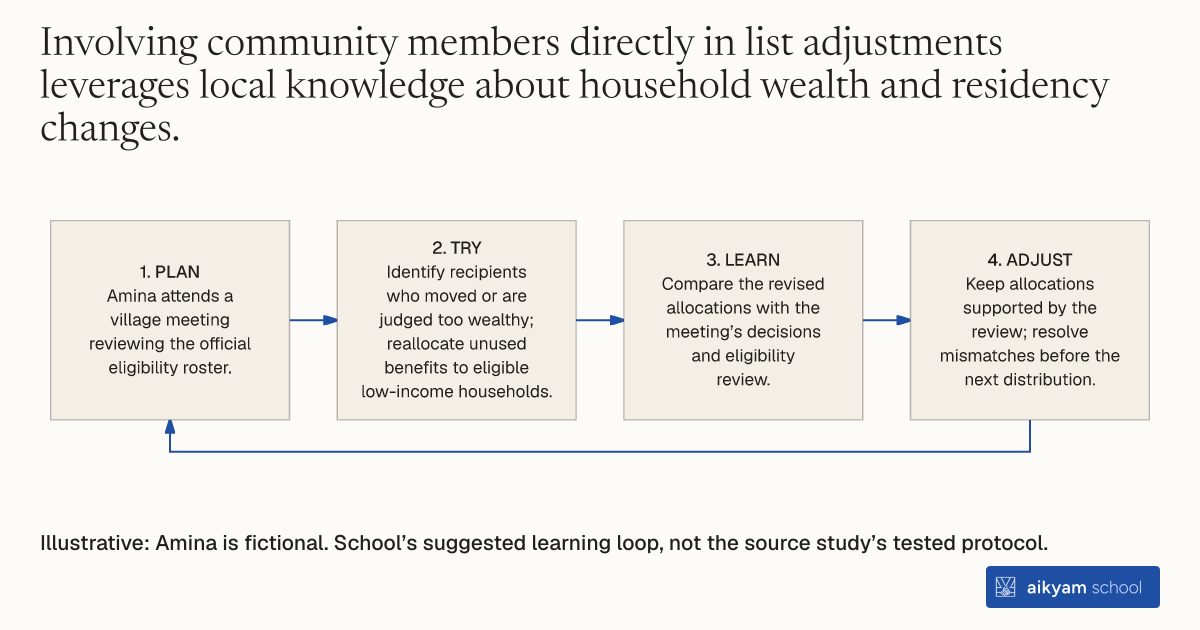
- Plan: Amina attends a village meeting reviewing the official eligibility roster.
- Try: Identify recipients who moved or are judged too wealthy; reallocate unused benefits to eligible low-income households.
- Learn: Compare the revised allocations with the meeting’s decisions and eligibility review.
- Adjust: Keep allocations supported by the review; resolve mismatches before the next distribution.
Illustrative: Amina is fictional. School’s suggested learning loop, not the source study’s tested protocol.
See source →School’s suggested learning loop: Observe residency, eligibility decisions and reallocations. This suggested loop is separate from the national scale-up procedure.
How
When to use
Official eligibility rosters can become outdated when residents move away or when household wealth changes over time. Local authorities require a transparent mechanism to update recipient lists without relying solely on top-down administrative decisions. Implement a local community engagement process to allow citizens to reallocate social benefit cards when individuals move or no longer qualify.
Incorporate a community engagement process into national benefit card distribution to allow local reallocation of social assistance cards.
- Convene village community meetings during the benefit card distribution process.
- Review the official eligibility roster publicly with meeting participants.
- Identify card recipients who have moved away from the village.
- Identify listed households that the community consensus deems too wealthy to qualify for social assistance.
- Reallocate the unused or revoked benefit cards to eligible low-income households identified by the community.
Why it works
This open decision-making prevents local leader corruption while ensuring benefits reach current low-income residents.
Example
During the 2013 national scale-up of social benefit cards in Indonesia reaching 15.5 million households, the government incorporated local community engagement processes. This allowed local communities to reallocate benefit cards away from households that moved or were deemed too wealthy.
About the study
Participants
15.5 million low-income households reaching over 65 million people across Indonesia during the national program scale-up.
Study Design
Nationwide policy scale-up informed by randomized evaluation findings and an accompanying trial on community targeting mechanisms.
Results
Incorporating community engagement enabled local reallocations of benefit cards during the national scale-up to 15.5 million households across the country.