Research steps
Estimate capacity from ten-day trip recall
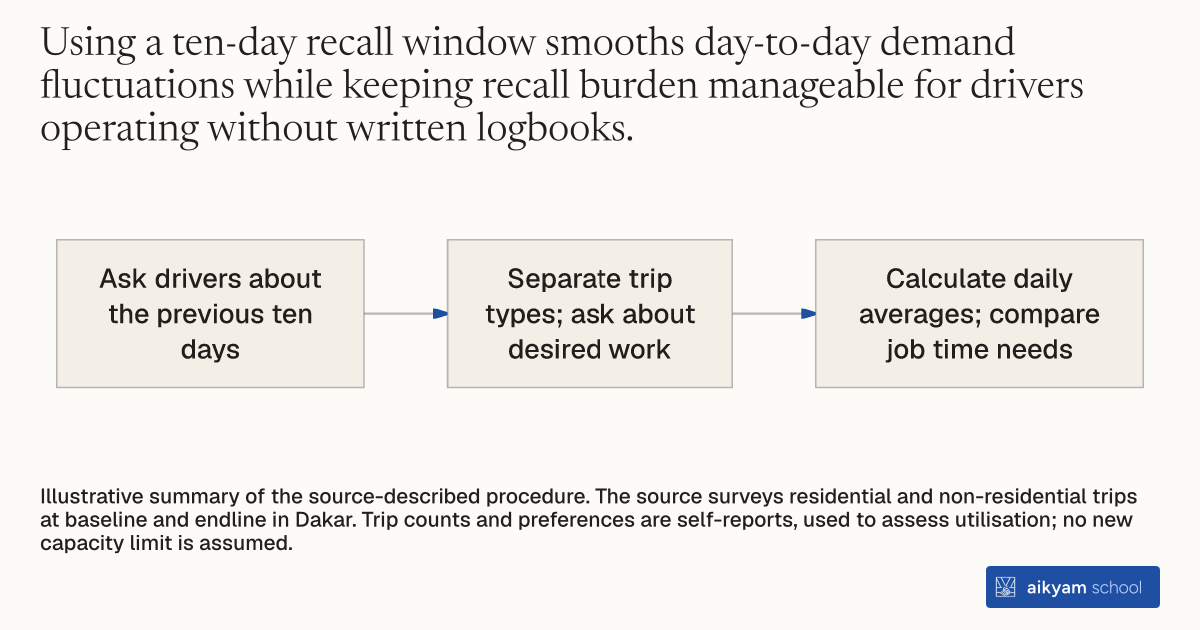
- Ask drivers about the previous ten days
- Separate trip types; ask about desired work
- Calculate daily averages; compare job time needs
Illustrative summary of the source-described procedure. The source surveys residential and non-residential trips at baseline and endline in Dakar. Trip counts and preferences are self-reports, used to assess utilisation; no new capacity limit is assumed.
See source →How
When to use
Researchers need to estimate production capacity and quantify excess capacity among decentralized service providers in informal transport sectors. The method addresses missing administrative logs and unobservable vehicle utilization rates when assessing whether high service prices stem from physical supply constraints or market power. It is designed for study teams evaluating operator conduct and market efficiency in urban utility or freight transport markets.
Estimate vehicle production capacity and labor utilization by surveying commercial drivers about their total trip counts over a fixed multi-day recall window.
- Survey enumerators contact commercial vehicle operators at their primary parking garages or via phone.
- Enumerators ask drivers to state the total number of service trips completed over the preceding ten-day period.
- Enumerators distinguish between residential and non-residential trips within the recall window.
- Enumerators record self-reported driver preferences regarding whether operators desire additional job volume to increase earnings.
- Survey analysts calculate daily trip averages and compare trip distributions against physical time requirements per job to estimate fleet-wide excess capacity.
Why it works
Comparing reported trip volume against maximum achievable daily trips distinguishes physical capacity bottlenecks from deliberate supply restrictions.
Example
Researchers in Dakar, Senegal asked vacuum truck operators in baseline and endline provider surveys how many desludging trips they performed over the last ten days. Drivers averaged slightly more than one trip per day, with 85% reporting that they could find more jobs if they wanted to make more money, confirming substantial excess capacity across the market.
About the study
Participants
121 truck operators at baseline in mid-2012 and 152 drivers (including 13 owner-operators), 75 truck owners, and 20 managers at endline in mid-2015 surveyed across garages in Dakar, Senegal.
Study Design
Survey-based recall study administering a ten-day trip recall module and capacity assessment to vacuum truck operators across baseline and endline survey waves.
Results
Drivers performed an average of slightly more than 1 trip per day (residential and commercial combined) while the top 10% performed over 3 jobs per day and the most active truck completed 50 trips in 10 days, with 85% of operators reporting excess capacity.