Try, learn and adjust
Use farmer feedback to adjust service delivery
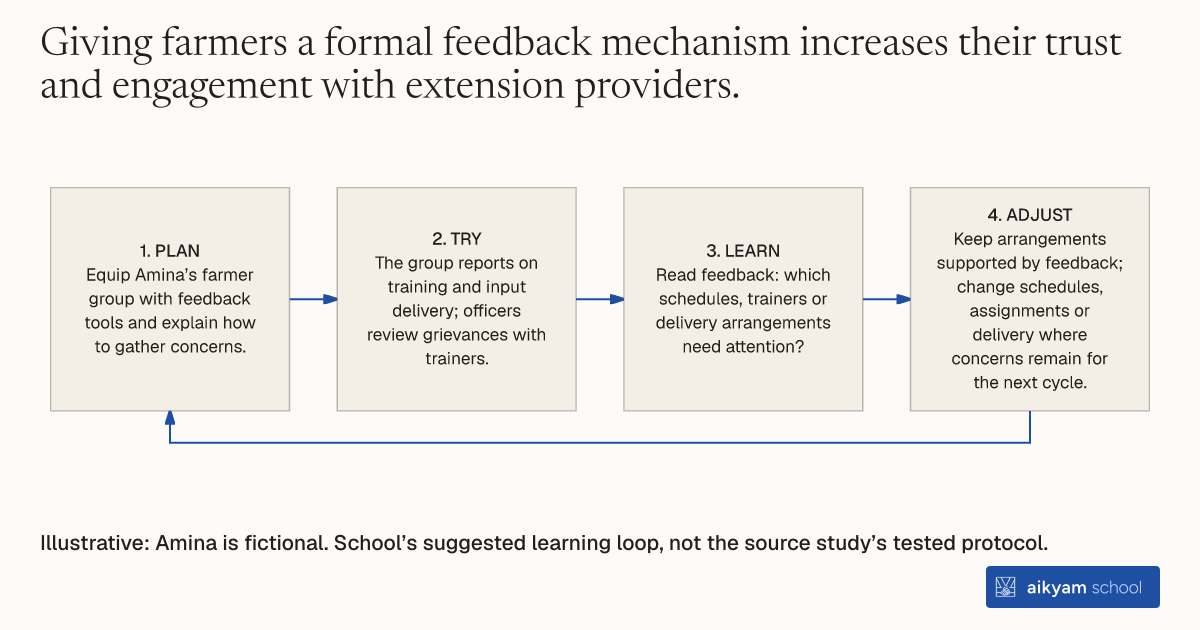
- Plan: Equip Amina’s farmer group with feedback tools and explain how to gather concerns.
- Try: The group reports on training and input delivery; officers review grievances with trainers.
- Learn: Read feedback: which schedules, trainers or delivery arrangements need attention?
- Adjust: Keep arrangements supported by feedback; change schedules, assignments or delivery where concerns remain for the next cycle.
Illustrative: Amina is fictional. School’s suggested learning loop, not the source study’s tested protocol.
See source →School’s suggested learning loop; not a tested source procedure. Observe reported concerns, service changes and member retention. The source’s retention finding does not establish this illustrative loop’s impact.
How
When to use
Agricultural extension programs and input delivery services frequently suffer from high participant attrition when farmers lack trust or mechanisms to report issues. Without structured communication channels, extension providers fail to address grievances or adapt training to farmer needs. This method helps service managers gather direct feedback from farmer groups to improve engagement and maintain long-term participation.
Establish structured feedback mechanisms for farmer groups to report on training quality and input service delivery.
- Extension service directors establish standardized feedback collection tools for participating farmer groups.
- Group leaders receive instruction on gathering concerns and evaluating extension training sessions with group members.
- Farmer groups periodically complete feedback reports regarding trainer performance, input delivery, and service quality.
- Program officers collect feedback submissions and review reported grievances with field trainers.
- Service managers adjust extension schedules, trainer assignments, or service delivery based on reported farmer preferences.
Why it works
Aligning extensionists' accountability with beneficiary evaluations sustains farmer demand and prevents group members from abandoning services.
Example
In Rwanda, farmer groups were provided with access to feedback tools for an agricultural input and training service. Farmer groups with access to feedback tools were half as likely to have members leave the service in the following year as comparison farmer groups.
About the study
Participants
Smallholder farmer groups participating in agricultural input and training services in Rwanda.
Study Design
Randomized evaluation testing whether providing farmer groups with structured feedback tools for agricultural input and advisory services reduced service drop-out rates.
Results
Farmer groups who received access to feedback tools were half as likely to have members leave the service in the following year as comparison farmer groups.