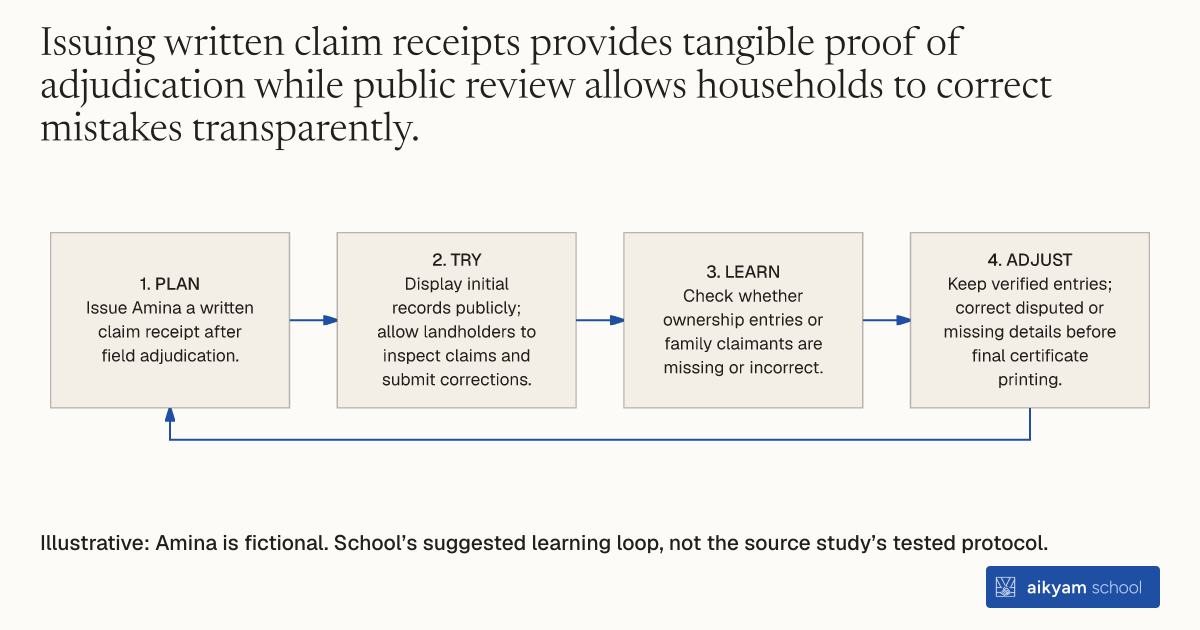
Try, learn and adjust
Check land claims before certificate printing
- Plan: Issue Amina a written claim receipt after field adjudication.
- Try: Display initial records publicly; allow landholders to inspect claims and submit corrections.
- Learn: Check whether ownership entries or family claimants are missing or incorrect.
- Adjust: Keep verified entries; correct disputed or missing details before final certificate printing.
Illustrative: Amina is fictional. School’s suggested learning loop, not the source study’s tested protocol.
See source →School’s suggested learning loop: Observe receipts, public inspection and verified corrections. This check does not establish tenure effects.
How
When to use
Landowners require formal written proof of their claims during systematic registration to review recorded details for errors or missing claimants. Omissions or boundary errors can lead to future land disagreements if not identified promptly. Land authorities issue written claim receipts and conduct objection periods so households can correct land records before final certificate printing.
Issue written claim receipts to property owners following demarcation and allow a public review period to correct record omissions.
- Field parasurveyors record land claims and hand a written claim receipt to each participating landowner.
- Local land committees publicly display initial adjudication records in village cells for public inspection.
- Landholders examine displayed claim lists to identify incorrect ownership entries or missing family claimants.
- Landowners submit formal correction requests to land administration officers during the objections period.
- Program staff verify land records and update administrative databases before printing final certificates.
Example
In rural Rwanda, field teams issued written claim receipts to 71 percent of landholders following initial demarcation. During the public review process, omission and correction procedures took place for 13 percent of all recorded parcels across sampled villages.
About the study
Participants
3,600 households across 13,416 parcels in 300 villages in rural Rwanda.
Study Design
Cluster-randomized evaluation comparing 50 early-implementation sectors to 50 late-implementation sectors using difference-in-differences analysis on household survey data.
Results
Claim receipts were received for 71 percent of total parcels, and formal omission and correction took place on 13 percent of parcels.