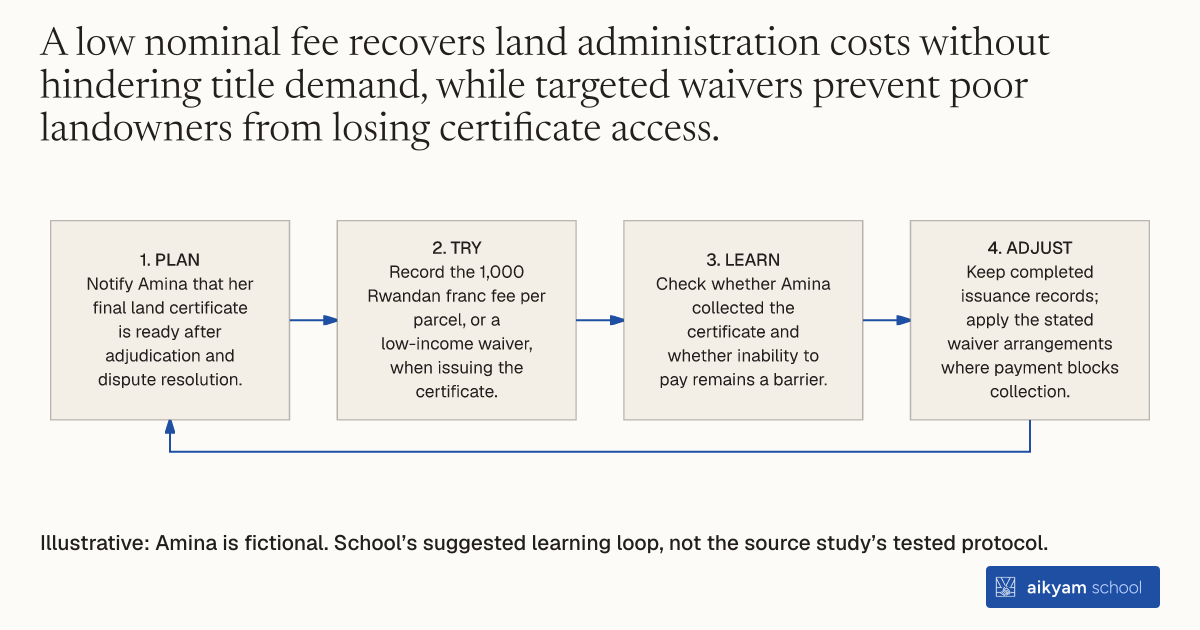
Try, learn and adjust
Check certificate collection and fee access
- Plan: Notify Amina that her final land certificate is ready after adjudication and dispute resolution.
- Try: Record the 1,000 Rwandan franc fee per parcel, or a low-income waiver, when issuing the certificate.
- Learn: Check whether Amina collected the certificate and whether inability to pay remains a barrier.
- Adjust: Keep completed issuance records; apply the stated waiver arrangements where payment blocks collection.
Illustrative: Amina is fictional. School’s suggested learning loop, not the source study’s tested protocol.
See source →School’s suggested learning loop: Observe collection, fee payments and waivers. The source describes fees being lifted later for poorer rural households.
How
When to use
High administrative costs for land registration can block low-income households from securing legal land titles. Land authorities charge a small flat fee per parcel to cover administrative expenses when owners pick up their land lease certificates. Governments subsequently lift or waive this fee for poorer rural households to ensure universal titling access.
Charge a nominal flat fee when landowners collect land certificates and waive the cost for low-income households.
- Land administration offices print final land lease certificates following adjudication and dispute resolution.
- Local offices notify landholders to pick up their printed certificates at sector or cell collection points.
- Administrative staff collect a flat fee of 1,000 Rwandan francs (1.7 USD) per parcel from landholders upon certificate pickup.
- Land authorities record fee payments and issue official title certificates to paying property owners.
- Authorities grant fee waivers to low-income rural households unable to afford the issuance cost.
Example
In rural Rwanda, land offices charged 1,000 Rwandan francs (1.7 USD) per parcel upon title collection. Only 38 percent of landholders paid the fee immediately during initial rollout, with 83 percent of non-payers stating they would pay later, leading the government to lift the fee for poorer rural households.
About the study
Participants
3,600 households across 13,416 parcels in 300 villages in rural Rwanda.
Study Design
Cluster-randomized evaluation comparing 50 early-implementation sectors to 50 late-implementation sectors using difference-in-differences analysis on household survey data.
Results
At baseline, 71 percent of households were willing to pay for certificates, but only 38 percent paid upon pickup during early implementation (24 percent in bottom asset quartile vs 52 percent in top quartile); 6 percent reported inability to afford the fee (12 percent for female-headed households).