Research steps
Record nomination payments after party selection
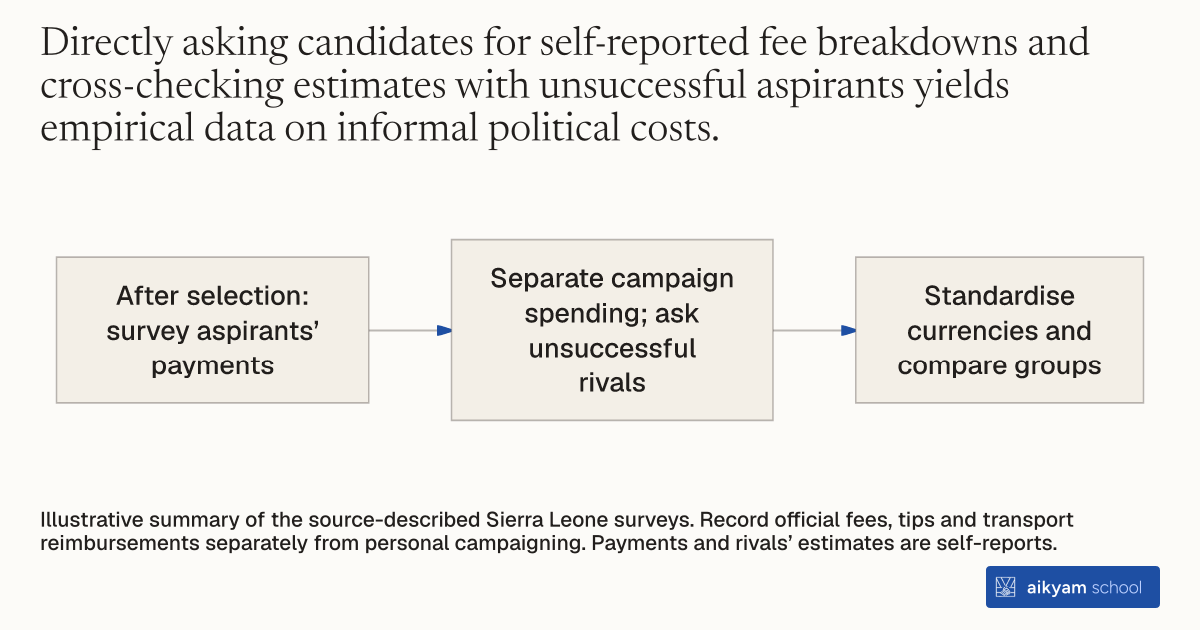
- After selection: survey aspirants’ payments
- Separate campaign spending; ask unsuccessful rivals
- Standardise currencies and compare groups
Illustrative summary of the source-described Sierra Leone surveys. Record official fees, tips and transport reimbursements separately from personal campaigning. Payments and rivals’ estimates are self-reports.
See source →How
When to use
Political parties and election monitoring organizations need to determine whether financial nomination fees and unofficial payments create severe entry barriers or lead to candidate seats being sold to top payers. Surveying candidate aspirants about their official application fees and unofficial party contributions enables researchers to evaluate campaign cost burdens. This method helps political organizations assess how nomination costs affect candidate selection and aspirant entry.
Elicit detailed financial contribution data from candidate aspirants following official candidate announcements to quantify nomination fees and unofficial party payments.
- Schedule post-nomination survey interviews with candidate aspirants across target constituencies after official party selections are published.
- Direct survey enumerators to ask each aspirant the exact monetary amount paid to party leaders to secure the party nomination symbol, specifying official registration fees, tips, and transportation reimbursements.
- Ask candidate aspirants to report their own personal campaign expenditures separately from party payments.
- Interview unsuccessful aspirants to record their estimates of the financial contributions made by the selected candidates in their respective pools.
- Convert self-reported contribution amounts into standardized values in local currency and United States dollars.
- Compare financial contribution levels across treatment conditions and constituency competitiveness levels to analyze candidate willingness to pay.
Why it works
Comparing these financial figures against candidate selection outcomes reveals whether party nominations favor the highest bidder or reflect expected returns to office.
Example
Enumerators surveyed candidate aspirants across Parliamentary constituencies in Sierra Leone following official candidate announcements in January 2018, measuring official application fees and informal party contributions across 92 party-races.
About the study
Participants
390 candidate aspirants across 80 Parliamentary constituencies in Sierra Leone, where 89 percent were male, averaging 47.56 years of age and 15.32 years of education, with 80 percent having university education.
Study Design
Post-nomination survey elicitation comparing self-reported official fees and informal party payments across treatment and control constituencies in a randomized controlled trial.
Results
Across control races, 89.7 percent of aspirants made nonzero contributions averaging \$2,392 (equivalent to 1.3 months of an MP's salary and 34 times the monthly minimum wage), and selected candidates self-reported the highest contribution in their pool in only 36 percent of control races.