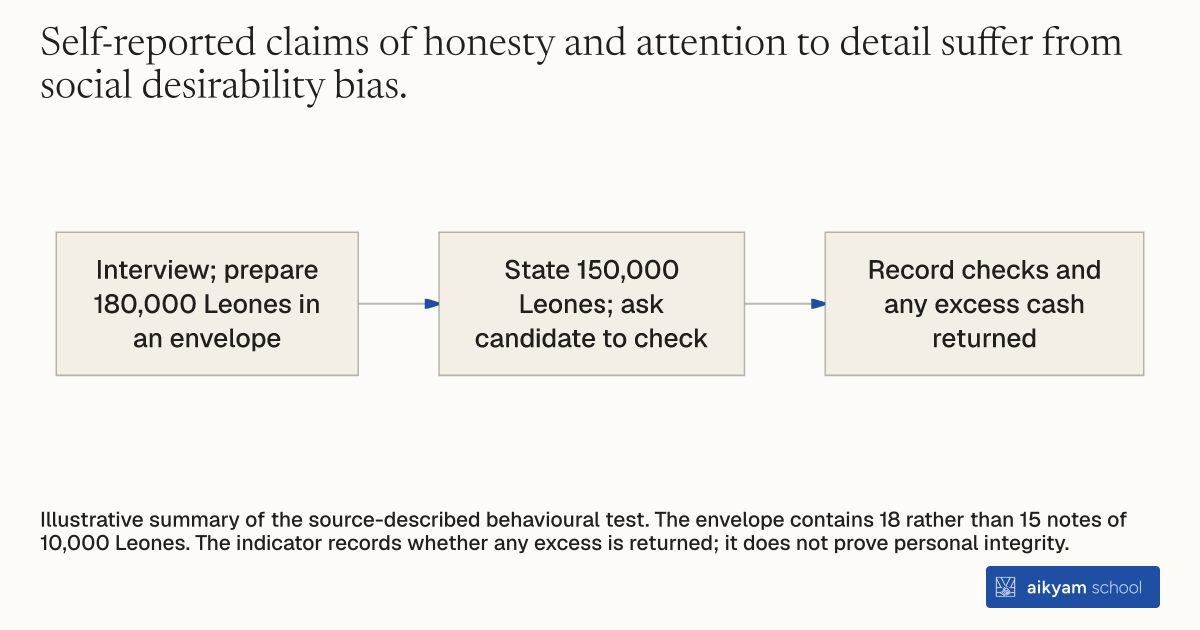
Research steps
Record responses to an overpaid reimbursement
- Interview; prepare 180,000 Leones in an envelope
- State 150,000 Leones; ask candidate to check
- Record checks and any excess cash returned
Illustrative summary of the source-described behavioural test. The envelope contains 18 rather than 15 notes of 10,000 Leones. The indicator records whether any excess is returned; it does not prove personal integrity.
See source →How
When to use
Political parties often struggle to evaluate the personal integrity, attention to detail, and conscientiousness of candidate aspirants through standard interviews or self-reported resumes alone. Handing candidates an overpaid cash reimbursement envelope during routine interactions provides an objective behavioral test of honesty and vigilance. This approach helps political organizations measure baseline candidate conscientiousness before issuing nomination symbols.
Measure candidate conscientiousness by overpaying travel expense reimbursements during survey interviews and recording whether candidates detect and return the excess funds.
- Schedule in-person survey or screening interviews with political candidate aspirants at local administrative headquarters.
- Prepare cash reimbursement envelopes for travel expenses, intentionally inserting extra banknotes above the stated disbursement amount.
- Hand the envelope to the candidate following the interview, verbally stating the intended reimbursement amount and asking them to verify that the cash inside is correct.
- Record whether the candidate checks the envelope contents in the presence of staff or subsequently returns the extra banknotes.
- Code conscientiousness as a binary behavioral indicator based on whether the candidate returns any portion of the excess cash.
Why it works
Observing real-time cash handling behavior creates an unannounced test that directly measures a candidate's practical conscientiousness and personal integrity.
Example
Field enumerators tested 390 candidate aspirants across Sierra Leone during the 2018 Parliamentary election campaign by giving each an envelope stated to contain 150,000 Leones for travel expenses that actually contained 180,000 Leones; 46 percent of aspirants detected and returned the extra three bills.
About the study
Participants
390 candidate aspirants across 80 Parliamentary constituencies in Sierra Leone, of whom 89 percent were male, averaging 47.56 years of age and 15.32 years of education, with 80 percent having university education.
Study Design
A behavioral experiment embedded within candidate intake surveys across 92 party-races, where enumerators handed overpaid travel reimbursement envelopes to candidate aspirants and recorded return rates.
Results
Overall, 46 percent of candidate aspirants returned the extra banknotes; returning the money was associated with a 5 percentage point increase in vote share among voters and a 9 percentage point increase among party officials.