Research groups
Randomise villages for sanitation evaluation
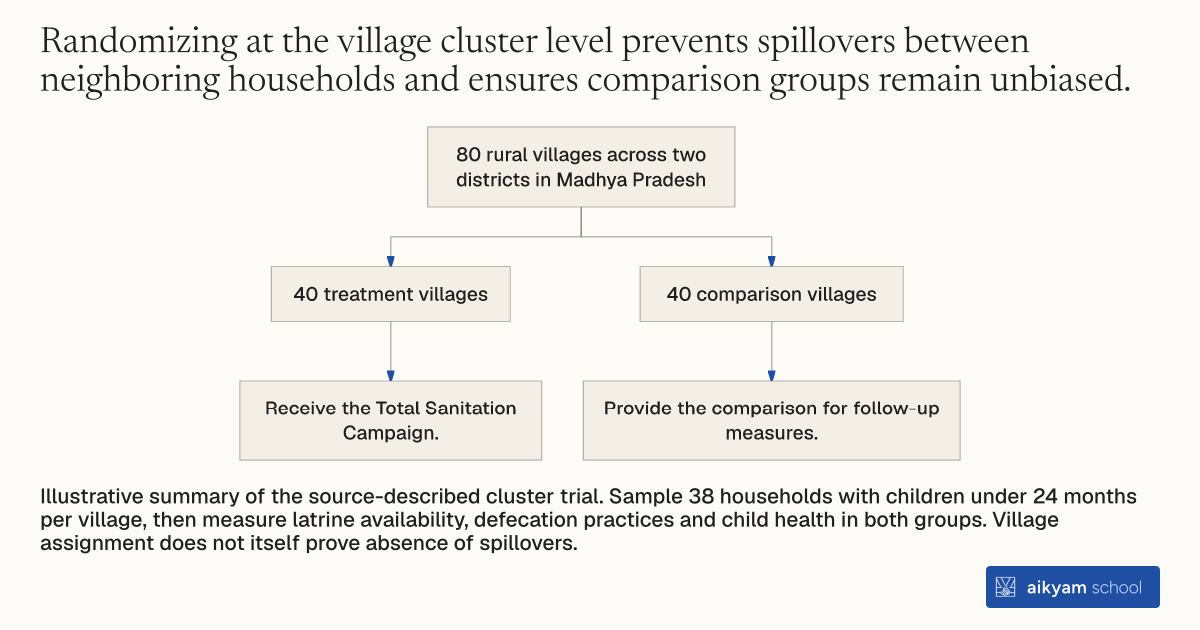
80 rural villages across two districts in Madhya Pradesh
- 40 treatment villages
- Receive the Total Sanitation Campaign.
- 40 comparison villages
- Provide the comparison for follow-up measures.
Illustrative summary of the source-described cluster trial. Sample 38 households with children under 24 months per village, then measure latrine availability, defecation practices and child health in both groups. Village assignment does not itself prove absence of spillovers.
See source →How
When to use
Public health interventions are often implemented at the village level, creating risks of local spillovers. Evaluating community-wide interventions requires measuring outcomes across randomized village clusters rather than individual households. This method assigns entire rural communities to treatment or comparison groups to evaluate sanitation impacts.
Measure the impact of village-wide sanitation programs using a cluster randomized trial structure.
- Program evaluators select participating districts and identify eligible rural villages willing to participate in the evaluation.
- Evaluators randomly assign half of the identified villages to receive the sanitation intervention and the remaining villages to a comparison group.
- Field teams sample eligible households within each village, selecting 38 families with children under 24 months of age per village.
- Researchers conduct follow-up surveys across treatment and comparison villages to measure latrine availability, defecation practices, and child health.
Why it works
Comparing outcomes across clusters provides rigorous evidence on the true effectiveness of community-wide interventions.
Example
In rural Madhya Pradesh, India, researchers selected two districts and identified 80 participating villages, randomly assigning 40 villages to receive the Total Sanitation Campaign and 40 villages to serve as comparison clusters. Within each village, researchers randomly selected 38 households with children under 24 months of age to measure program impacts on latrine availability, open defecation, and child health.
About the study
Participants
80 rural villages across two districts in Madhya Pradesh, India, sampling 38 households with children under 24 months of age per village.
Study Design
Cluster randomized evaluation assigning 40 villages to the intervention group and 40 villages to the comparison group.
Results
The evaluation revealed that improved sanitation facility access increased to 41.4 percent in treatment villages (versus 22.4 percent in comparison villages) and daily open defecation decreased by 11 to 12 percent, but child health outcomes showed no statistically significant differences.