Research steps
Measure haemoglobin during home surveys
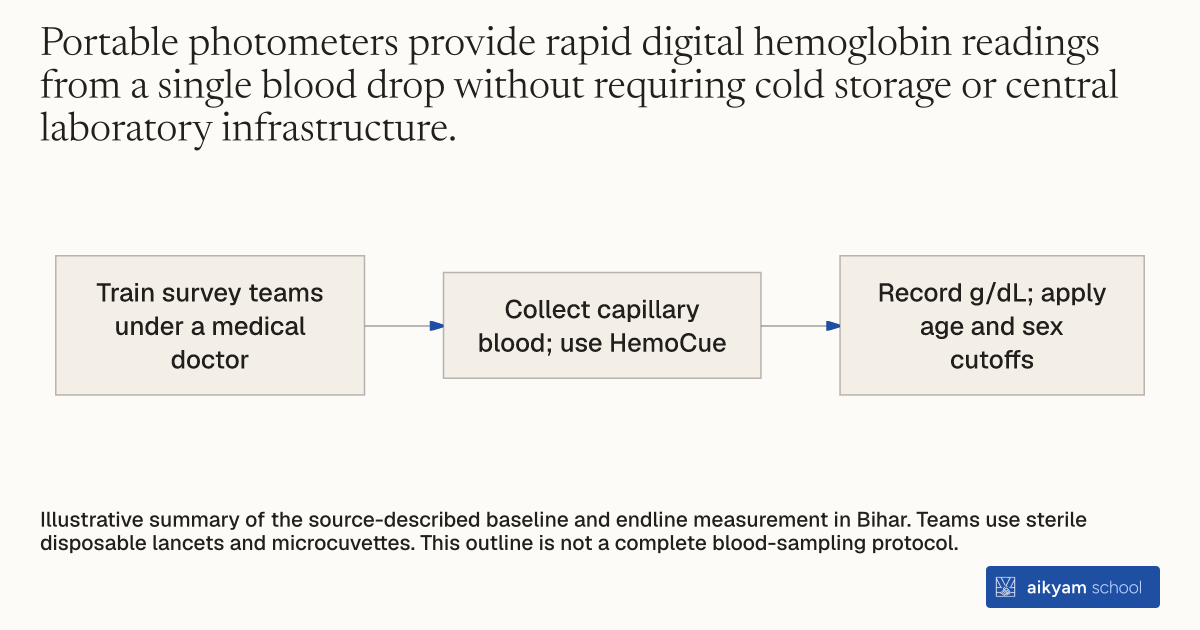
- Train survey teams under a medical doctor
- Collect capillary blood; use HemoCue
- Record g/dL; apply age and sex cutoffs
Illustrative summary of the source-described baseline and endline measurement in Bihar. Teams use sterile disposable lancets and microcuvettes. This outline is not a complete blood-sampling protocol.
See source →How
When to use
Public health evaluations in low-resource rural settings require reliable field screening for iron deficiency anemia. Laboratory venous blood draws are often impractical across distant village populations. Capillary hemoglobin measurement using portable photometers allows survey teams to assess anemia prevalence directly inside respondents' homes.
Measure individual hemoglobin concentration in field settings using portable photometers to evaluate health status and population anemia prevalence.
- Train field survey teams under the direction of a medical doctor on hygienic blood sampling and photometer operation.
- Visit sampled households across target villages during baseline and endline survey rounds.
- Prick the respondent's finger using a sterile disposable lancet to obtain a capillary blood drop.
- Collect the blood drop into a microcuvette and insert it into a portable HemoCue photometer.
- Record the digitally displayed hemoglobin concentration in grams per deciliter and apply age and gender cutoffs to identify anemic individuals.
Why it works
This enables non-medical field surveyors to collect immediate, standardized diagnostic data across large rural populations.
Example
Survey staff trained by a medical doctor conducted capillary blood testing using HemoCue photometers across 400 rural villages in Bhojpur district, Bihar, measuring baseline hemoglobin for 31,710 individuals and endline hemoglobin for 34,732 individuals.
About the study
Participants
31,710 baseline individuals and 34,732 endline individuals across 400 rural villages in Bhojpur district, Bihar, with an average baseline age of 28 years and 45 percent baseline anemia prevalence.
Study Design
Survey teams measured individual hemoglobin levels via HemoCue finger-prick testing at baseline and 30-month endline across 200 sales treatment villages, 62 embedded free distribution villages, and control villages.
Results
HemoCue measurements recorded a baseline mean hemoglobin of 12.197 g/dL, detecting endline changes of 0.033 g/dL in sales villages (95% CI: -0.024 to +0.09 g/dL) and -0.007 g/dL in free distribution villages relative to non-free village peers.