Research procedure
Track haemoglobin and anaemia
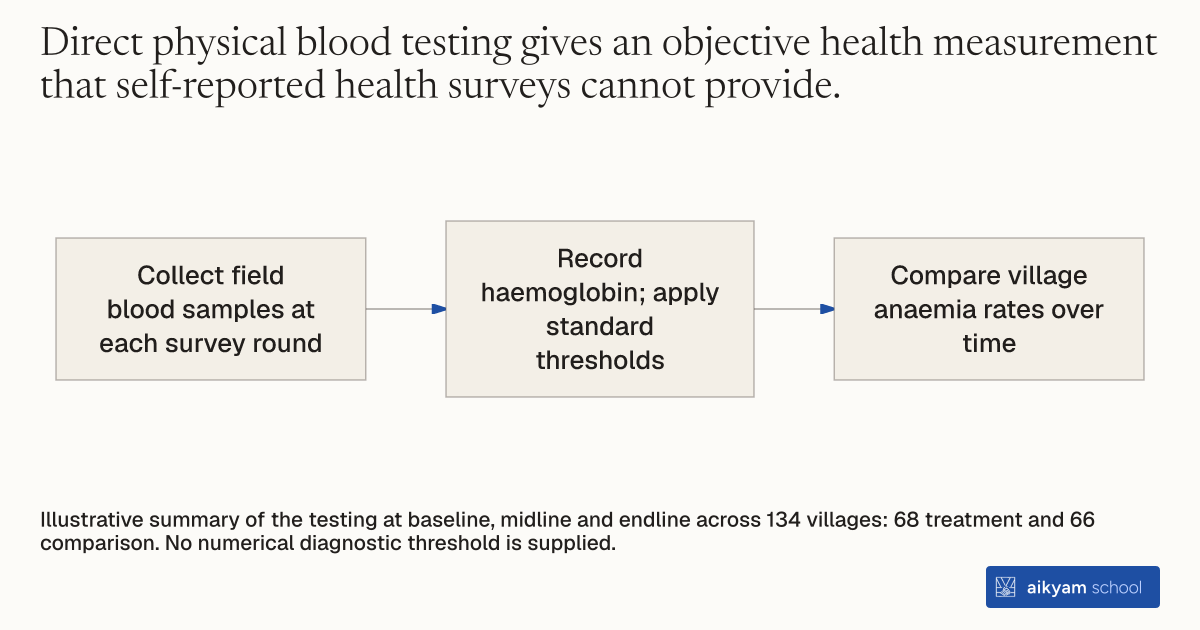
- Collect field blood samples at each survey round
- Record haemoglobin; apply standard thresholds
- Compare village anaemia rates over time
Illustrative summary of the testing at baseline, midline and endline across 134 villages: 68 treatment and 66 comparison. No numerical diagnostic threshold is supplied.
See source →How
When to use
Rural populations in low-income settings frequently suffer from undetected iron deficiency anemia. Standard surveys without blood testing fail to diagnose anemia because physical symptoms overlap with other conditions. Direct hemoglobin testing measures blood iron levels directly to identify anemia prevalence across rural communities.
Measure hemoglobin levels in community members using field blood tests to diagnose anemia rates across targeted villages.
- Surveyors visit adult residents in participating rural villages during baseline, midline, and endline study rounds.
- Surveyors obtain blood samples from participants using a portable testing device in the field.
- Surveyors record exact hemoglobin readings for each individual respondent.
- Surveyors classify participants as anemic based on standard hemoglobin thresholds.
- Researchers analyze village-level anemia rates to establish baseline needs and evaluate health intervention impacts over time.
Why it works
This allows researchers to accurately measure true anemia prevalence and track biological responses to fortification.
Example
In Udaipur District, India, researchers measured hemoglobin levels among adults across rural villages, finding baseline anemia rates of 51 percent for men and 56 percent for women, and detecting a 7 percentage point reduction in anemia at midline in treatment villages.
About the study
Participants
2,519 adults in 134 rural villages in Udaipur District, Rajasthan, India, where over 40 percent of households lived below the poverty line.
Study Design
Randomized evaluation across 134 villages (68 treatment and 66 comparison) using direct hemoglobin testing at baseline, midline, and endline survey rounds.
Results
Baseline screening revealed anemia in 51 percent of men and 56 percent of women; midline testing showed a 7 percentage point reduction in anemia in treatment villages during high program uptake, but endline testing showed no significant difference after uptake declined.