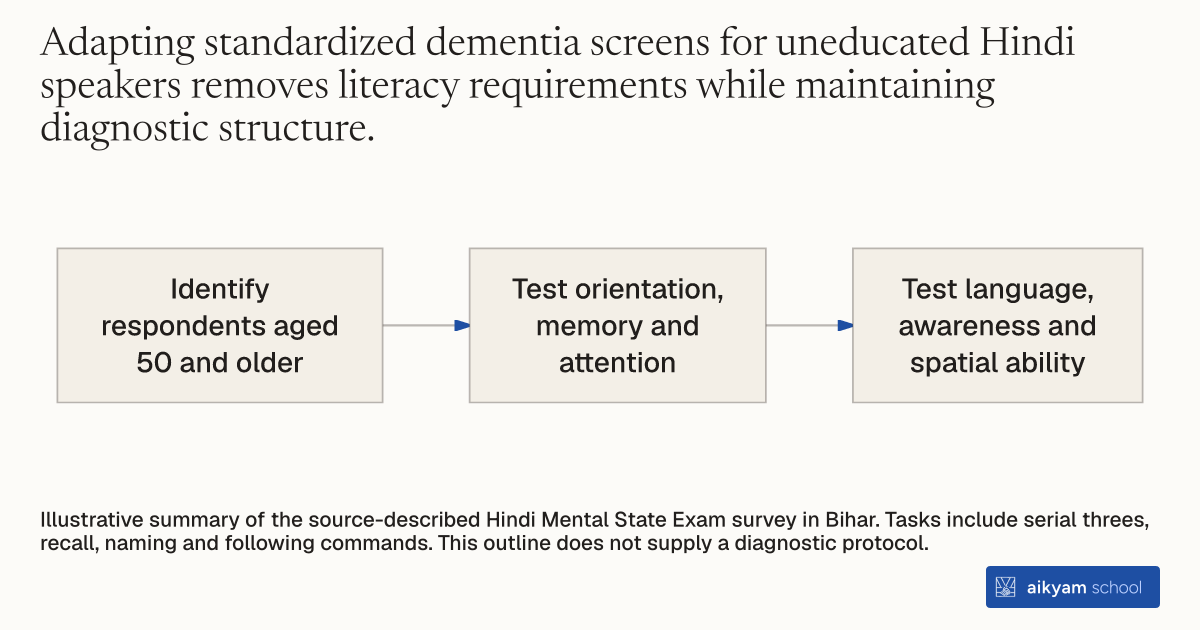
Research steps
Assess older adults with the Hindi exam
- Identify respondents aged 50 and older
- Test orientation, memory and attention
- Test language, awareness and spatial ability
Illustrative summary of the source-described Hindi Mental State Exam survey in Bihar. Tasks include serial threes, recall, naming and following commands. This outline does not supply a diagnostic protocol.
See source →How
When to use
Public health evaluations in low-income rural communities require simple tools to assess cognitive health among older adults. Traditional cognitive exams designed for educated English speakers fail when administered to illiterate rural populations. Administering the Hindi Mental State Exam evaluates basic cognitive awareness and alertness among elderly individuals with little or no formal schooling.
Assess cognitive awareness and dementia symptoms among elderly adults using an adapted verbal and practical testing battery.
- Identify all household respondents aged 50 years and older during field survey visits.
- Test orientation to time and orientation to place using localized Hindi questions.
- Assess registration and short-term memory by asking the participant to register and recall basic everyday objects.
- Test concentration and attention by asking the respondent to subtract serial threes.
- Evaluate language and comprehension by having the participant name common items, repeat a phrase, and follow visual and three-step verbal commands.
- Check personal awareness and spatial ability by asking the respondent to describe their home and copy a simplified visual figure.
Why it works
Testing orientation, memory, and task execution directly measures cognitive function in low-resource village settings.
Example
Survey teams administered the Hindi Mental State Exam to 5,279 elderly adults aged 50 and older across study villages in Bhojpur district, Bihar. Cognition scores for elderly adults in sales treatment villages were 0.046 standard deviations higher than control group peers, though the gain was not statistically significant after adjusting for multiple testing.
About the study
Participants
5,279 elderly individuals aged 50 years and older across 400 rural villages in Bhojpur district, Bihar, where 18.2 percent of baseline study participants were elderly.
Study Design
Survey staff administered the adapted Hindi Mental State Exam during household endline surveys across sales, free distribution, and control villages to measure elderly cognitive awareness.
Results
In the sales experiment, standardized elderly cognition scores changed by a statistically insignificant +0.046 standard deviations (95% CI: -0.011 to +0.103 SD, Q-value = 0.129); in the free DFS experiment, elderly cognition scores changed by -0.069 standard deviations (95% CI: -0.165 to +0.027 SD).