Research steps
Verify iron and iodine in salt
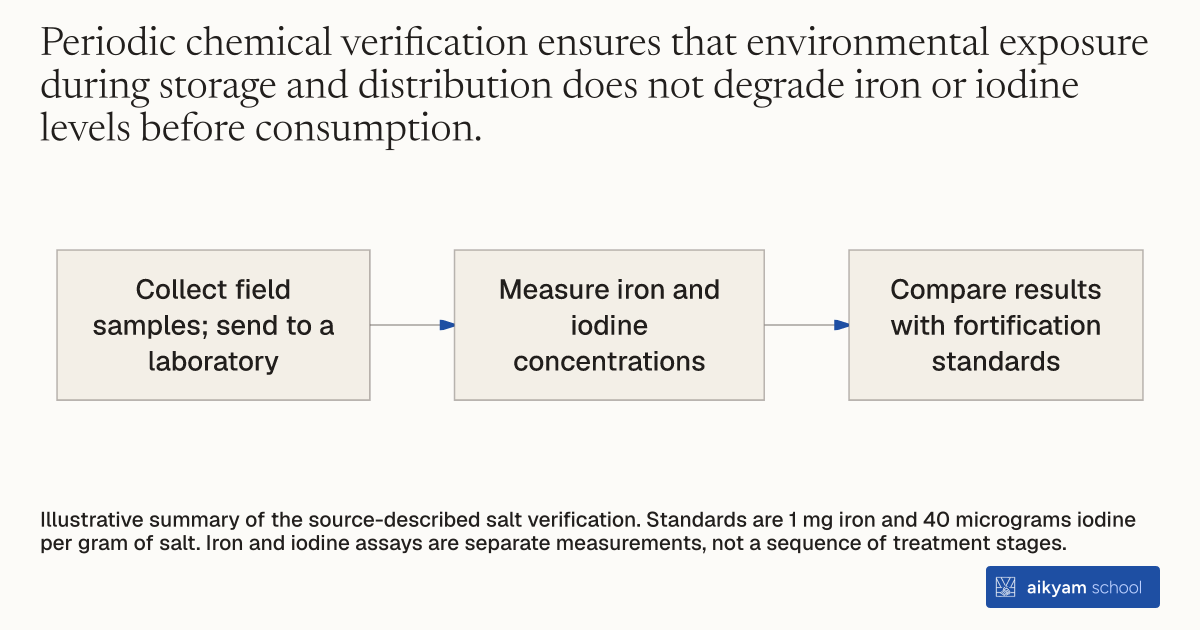
- Collect field samples; send to a laboratory
- Measure iron and iodine concentrations
- Compare results with fortification standards
Illustrative summary of the source-described salt verification. Standards are 1 mg iron and 40 micrograms iodine per gram of salt. Iron and iodine assays are separate measurements, not a sequence of treatment stages.
See source →How
When to use
In large-scale public health and food fortification trials, distributed products may suffer from micronutrient degradation during transit or storage. Without ongoing chemical verification, health programs risk distributing under-fortified salt that fails to deliver expected nutritional benefits. Conducting periodic laboratory assays of field salt samples verifies that iron and iodine concentrations remain stable and effective throughout distribution.
Test field salt samples in a laboratory to verify that micronutrient concentrations match required fortification levels.
- Collect packaged double-fortified salt samples periodically from village retail shops and household distribution points.
- Send collected salt samples to a certified research facility, such as the National Institute of Nutrition in Hyderabad.
- Perform quantitative chemical assays to measure the exact concentration of iron per gram of salt.
- Perform titration assays to measure the concentration of iodine present in each sample.
- Verify that iron content meets the required standard of 1 mg of iron per gram of salt and iodine content meets 40 micrograms per gram.
- Compare chemical results against production standards to ensure product stability across the supply chain.
Why it works
Testing through an independent scientific institute guarantees quality control across field implementation sites.
Example
Researchers partnered with the National Institute of Nutrition (Hyderabad) to conduct ongoing laboratory verifications of iron and iodine content in double-fortified salt samples distributed across 400 rural villages in Bhojpur district, Bihar.
About the study
Participants
Salt samples collected across 200 sales villages and 62 free distribution villages in Bhojpur district, Bihar, serving 6,000 baseline households.
Study Design
Quality control verification framework embedded within a cluster randomized trial where field salt samples were tested at the National Institute of Nutrition to assess iron (1 mg/g) and iodine (40 mcg/g) stability during a 30-month distribution period.
Results
Laboratory verifications confirmed the stability of 1 mg iron and 40 micrograms iodine per gram of salt in Tata Salt Plus, though general population consumption of the verified salt produced an statistically insignificant 0.033 g/dL hemoglobin change in sales villages.