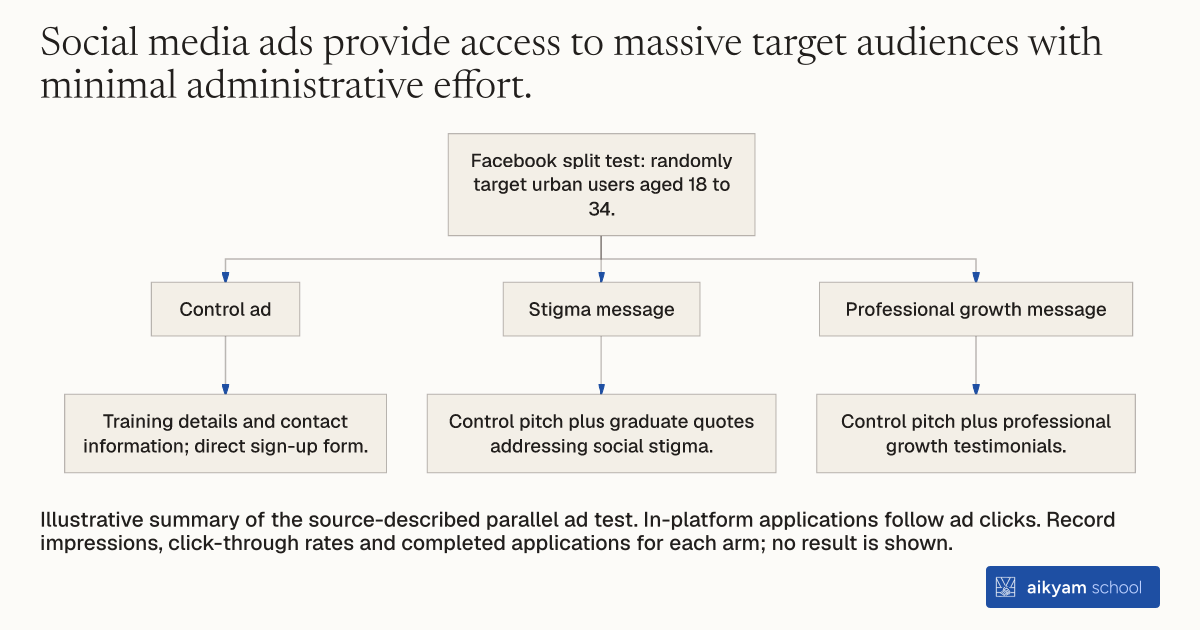
Research flow
Compare randomized recruitment ads
Facebook split test: randomly target urban users aged 18 to 34.
- Control ad
- Training details and contact information; direct sign-up form.
- Stigma message
- Control pitch plus graduate quotes addressing social stigma.
- Professional growth message
- Control pitch plus professional growth testimonials.
Illustrative summary of the source-described parallel ad test. In-platform applications follow ad clicks. Record impressions, click-through rates and completed applications for each arm; no result is shown.
See source →How
When to use
Digital advertising platforms enable rapid outreach to large populations of unemployed youth at low cost. Program administrators need a scalable method to test different messaging pitches and measure sign-up rates directly online. This method serves labor organizations seeking to recruit young jobseekers through social media platforms.
Run randomized split-test ad campaigns on Facebook to evaluate how different recruitment messages affect online training sign-ups.
- Create a control ad detailing job training topics, duration, class format, and organization contact information.
- Create treatment ads modifying the control pitch to include graduate quotes addressing social stigma or professional growth testimonials.
- Configure Facebook's split-testing platform to randomly assign targeted ads to social media users aged 18 to 34 in urban areas.
- Enable direct in-platform sign-up forms allowing users who click the ad to apply immediately.
- Record impression counts, click-through rates, and total completed sign-up applications for each ad arm.
Why it works
In-platform sign-up forms lower friction by enabling immediate candidate application without requiring visits to external websites.
Example
In late 2018, researchers reached 767,768 young adults aged 18 to 34 in Greater Cairo using Facebook split-test ads for job training. Relative to the control sign-up rate of 0.121 percent, professional stigma ads reduced sign-ups by 26 percent and social stigma ads reduced sign-ups by 39 percent.
About the study
Participants
767,768 young adults aged 18 to 34 in Greater Cairo, Egypt.
Study Design
Randomized split-test experiment on Facebook's advertising platform evaluating click-through and sign-up rates across control, social stigma, and professional stigma ads.
Results
Control sign-up rates reached 0.121 percent; professional stigma ads decreased sign-ups by 0.032 percentage points (26 percent reduction, p < 0.01) and social stigma ads decreased sign-ups by 0.047 percentage points (39 percent reduction, p < 0.01).