Try, learn and adjust
Check delivery of the job satisfaction pitch
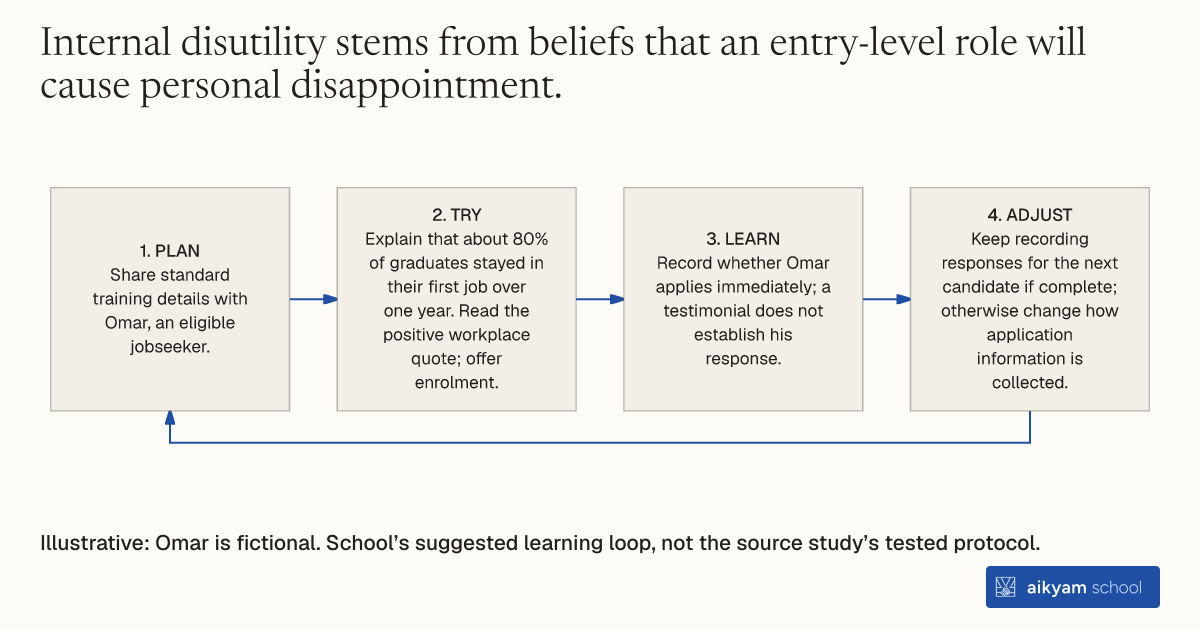
- Plan: Share standard training details with Omar, an eligible jobseeker.
- Try: Explain that about 80% of graduates stayed in their first job over one year. Read the positive workplace quote; offer enrolment.
- Learn: Record whether Omar applies immediately; a testimonial does not establish his response.
- Adjust: Keep recording responses for the next candidate if complete; otherwise change how application information is collected.
Illustrative: Omar is fictional. School’s suggested learning loop, not the source study’s tested protocol.
See source →School’s suggested, untested learning loop. Observe applications following the pitch; the study’s average application change was not statistically significant.
How
When to use
Jobseekers sometimes worry that entry-level positions will not be personally rewarding or enjoyable. Program managers need a recruitment pitch to address internal disappointment and self-image concerns. This method uses graduate job satisfaction survey statistics and alumni testimonials during street marketing to reassure candidates.
Deliver a recruitment pitch that combines standard job training details with statistics and quotes regarding alumni job satisfaction.
- Approach eligible unemployed young adults in public urban locations to discuss job training opportunities.
- Read the standard control pitch detailing class duration, interactive curriculum, location, and graduate average earnings.
- State that although some people think entry-level jobs are not very enjoyable, past graduates report high job satisfaction.
- Cite alumni survey records showing that about 80 percent of program graduates stayed in their first job for over one year.
- Read an alumni quote stating that they enjoyed their first job because the workplace was positive and enabled meeting new people.
- Offer the candidate immediate on-the-spot enrollment into the job training program.
Why it works
Sharing data on high job retention and positive work environments alleviates self-image concerns without triggering negative social or professional salience effects.
Example
Surveyors delivered the personal stigma pitch to 717 eligible youth in Cairo, Egypt during street outreach. The pitch led to a 0.6 percentage point increase in application rates relative to control, showing no negative salience backlash.
About the study
Participants
1,464 eligible unemployed and underemployed youth aged 18 to 35 in Greater Cairo, Egypt.
Study Design
Individual-level randomized field experiment comparing a control pitch against a personal stigma testimonial pitch during street recruitment.
Results
The personal stigma treatment increased application rates by 0.6 percentage points on average (control mean = 33.1 percent, p = 0.81) and showed no statistically significant heterogeneity between top and bottom machine learning groups (+0.073 vs +0.047, p = 0.756).