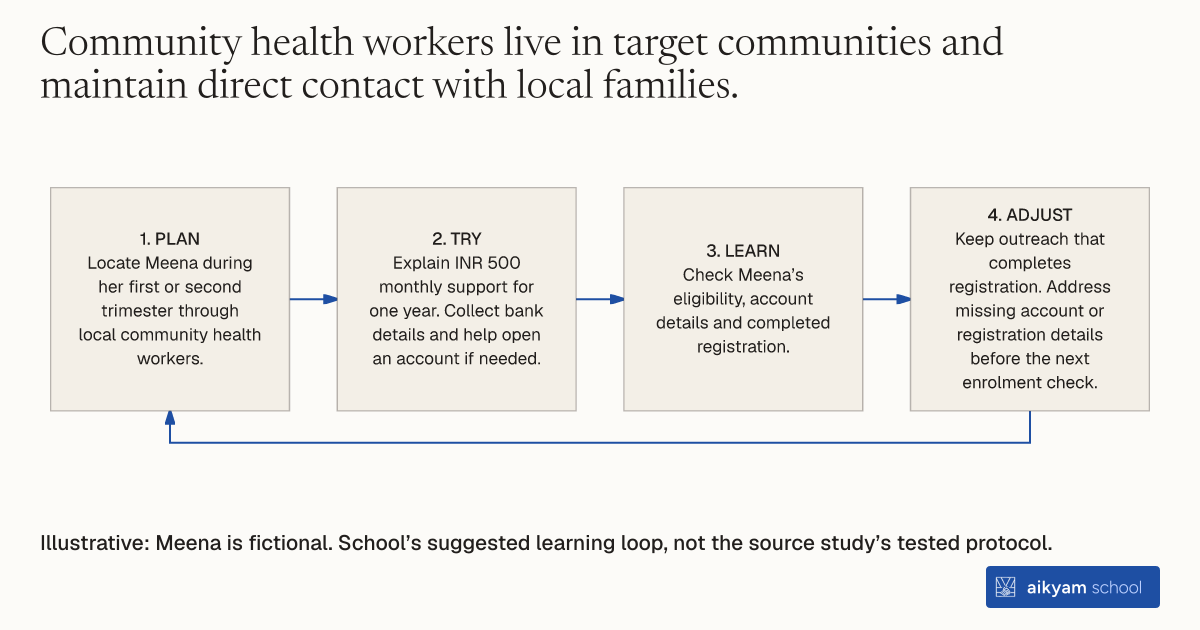
Try, learn and adjust
Check outreach reaches eligible pregnant women
- Plan: Locate Meena during her first or second trimester through local community health workers.
- Try: Explain INR 500 monthly support for one year. Collect bank details and help open an account if needed.
- Learn: Check Meena’s eligibility, account details and completed registration.
- Adjust: Keep outreach that completes registration. Address missing account or registration details before the next enrolment check.
Illustrative: Meena is fictional. School’s suggested learning loop, not the source study’s tested protocol.
See source →School’s suggested, untested loop. Observe eligibility and registration; programme impact results are forthcoming.
How
When to use
In rural areas of Jharkhand, low-income pregnant women and lactating mothers face severe undernutrition, while existing food distribution systems often fail to reach them. Local community health workers engage directly with these women to inform them of available financial support. This approach identifies eligible mothers during early pregnancy and registers them to receive direct cash transfers.
Deploy local community health workers at Anganwadi Centers to identify, inform, and enroll eligible pregnant women into cash transfer programs.
- Community health workers locate eligible pregnant women in their first and second trimesters across 960 Anganwadi Centers.
- Community health workers inform eligible women about their entitlement to receive unconditional monthly cash transfers of INR 500 (US\$7.66) for one year.
- Community health workers collect bank account details from eligible women to complete program registration.
- Community health workers assist women without existing bank accounts to open new bank accounts.
Why it works
Their direct outreach ensures that eligible pregnant women learn about financial assistance and complete bank registration without facing administrative barriers.
Example
In Jharkhand, local community health workers across 960 Anganwadi Centers identified pregnant women in their first and second trimesters and registered them to receive monthly cash transfers of INR 500 (US\$7.66) for one year.
About the study
Participants
Pregnant women and lactating mothers across 960 Anganwadi Centers in rural Jharkhand, India, where 43 percent of children under five are stunted and 37 percent of the population lives below the poverty line.
Study Design
Researchers partnered with the Government of Jharkhand to conduct a randomized controlled trial across 960 Anganwadi Centers, assigning centers to receive cash transfers across different timeframes or serve as a comparison group.
Results
Research is ongoing and final impact results are forthcoming; baseline data showed 39 percent of surveyed women registered for traditional ration allotments did not receive them.