Try, learn and adjust
Check health promoters complete both training areas
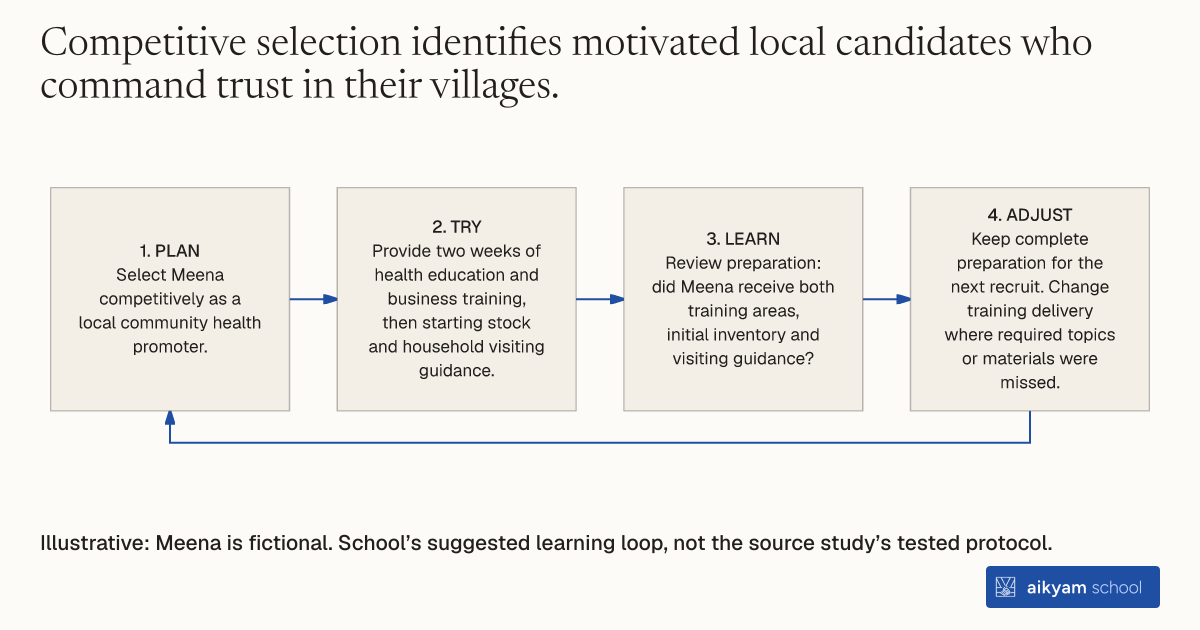
- Plan: Select Meena competitively as a local community health promoter.
- Try: Provide two weeks of health education and business training, then starting stock and household visiting guidance.
- Learn: Review preparation: did Meena receive both training areas, initial inventory and visiting guidance?
- Adjust: Keep complete preparation for the next recruit. Change training delivery where required topics or materials were missed.
Illustrative: Meena is fictional. School’s suggested learning loop, not the source study’s tested protocol.
See source →School’s suggested, untested loop. Observe training and start-up preparation. Child mortality effects belong to the wider programme, not training alone.
How
When to use
Many community health programs rely on unpaid volunteers who lack formal medical training and face weak performance incentives. This situation leads to low service coverage, low worker motivation, and high turnover in low-income regions with high child mortality. Selecting and preparing dedicated health workers through a competitive process provides a sustainable staffing solution for community health initiatives.
Recruit and prepare community health promoters through competitive selection and short-term dual-skills instruction.
- Non-governmental organizations recruit local community members through a competitive selection process in rural target villages.
- Selected candidates attend a two-week training program delivered by organization staff in local community centers.
- Trainers deliver health education on core topics including basic medical advice, home visits, and disease prevention.
- Trainers instruct candidates in essential micro-business management skills to prepare them for health commodity sales.
- Program managers supply newly trained promoters with starting wholesale inventories and household visiting guidelines.
Why it works
Combining health education with business training enables promoters to earn income while delivering reliable care.
Example
Living Goods and BRAC Uganda competitively selected health promoters across 115 rural villages in Uganda and trained them over two weeks in health education and business skills, contributing to a 27 percent drop in under-five child mortality across 7,000 surveyed households.
About the study
Participants
214 rural villages (115 treatment and 99 comparison villages) covering about 7,000 households and over 11,000 children in Uganda.
Study Design
Randomized controlled trial evaluating the program against comparison villages over three years using household surveys and Poisson rate ratio empirical models.
Results
Child mortality dropped by 27 percent (48.5 vs 68.4 deaths per 1,000 births), infant mortality dropped by 33 percent (32.4 vs 49.7 per 1,000), and neonatal mortality fell by 28 percent (24.1 vs 33.4 per 1,000).