Try, learn and adjust
Check facility reports before incentives are paid
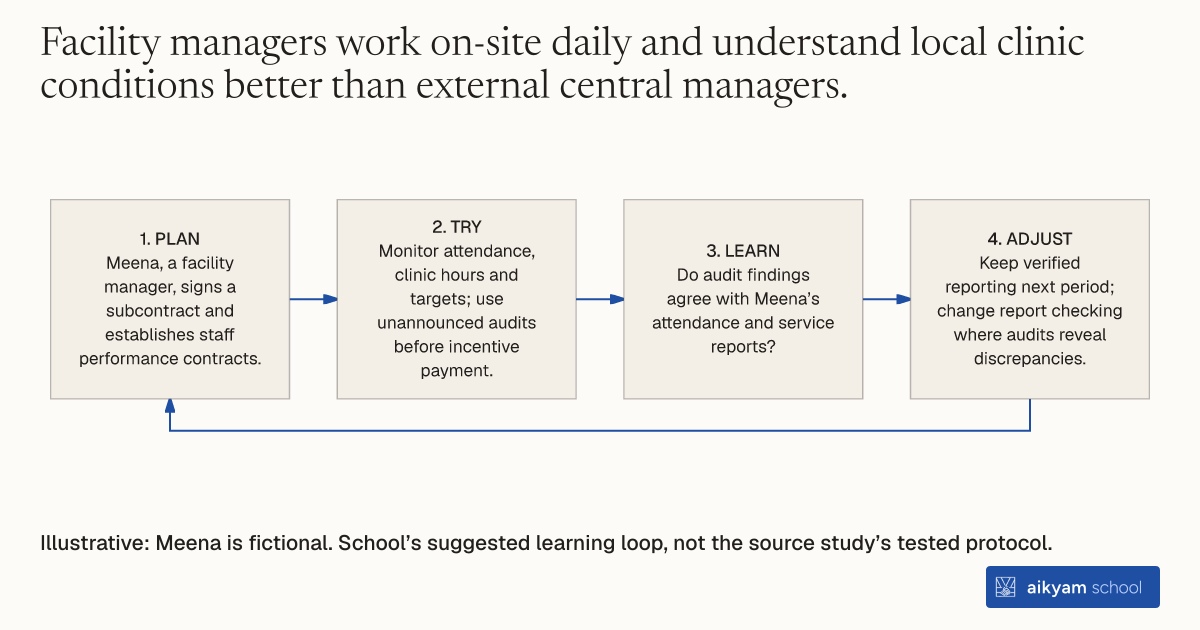
- Plan: Meena, a facility manager, signs a subcontract and establishes staff performance contracts.
- Try: Monitor attendance, clinic hours and targets; use unannounced audits before incentive payment.
- Learn: Do audit findings agree with Meena’s attendance and service reports?
- Adjust: Keep verified reporting next period; change report checking where audits reveal discrepancies.
Illustrative: Meena is fictional. School’s suggested learning loop, not the source study’s tested protocol.
See source →School’s suggested learning loop, not a tested source procedure. Observe staff presence, service hours and audit agreement; this does not isolate subcontracting effects from the management package.
How
When to use
Health management organisations struggle to manage individual performance contracts directly with numerous health workers across decentralized rural clinics. Centralized oversight fails to enforce daily health worker attendance or service standards across scattered health centers. Subcontract health center and hospital managers so local leadership directly oversees and enforces staff performance contracts.
Subcontract facility managers to negotiate, supervise, and enforce performance contracts with local health clinic staff.
- Delegate supervisory authority and staff incentive administration to health center and hospital managers across the district.
- Sign primary management subcontracts between the managing contractor and each facility manager.
- Require facility managers to establish downstream performance subcontracts with the health workers under their direct supervision.
- Offer staff compensation combining fixed salary supplements, performance bonuses, and punctuality bonuses.
- Empower facility managers to monitor daily staff attendance, clinic hours, and service target execution.
- Conduct regular unannounced field audits to verify facility manager reporting before releasing incentive payments.
Why it works
Delegating supervisory contracts to facility managers establishes a clear local chain of command and holds facility leaders directly accountable for team performance.
Example
In Pereang district of Prey Veng province, HealthNet International initially attempted to negotiate direct subcontracts with all staff members before switching to facility manager subcontracts. HealthNet International subcontracted hospital and health center managers, who then managed contracts for their supervised workers offering a 55% salary supplement, a 30% performance bonus, and a 15% punctuality bonus. This structure contributed to raising the presence of all scheduled health center staff by 50 percentage points over comparison facilities.
About the study
Participants
12 rural districts across Takeo, Prey Veng, and Kampong Cham provinces in Cambodia, covering 1.26 million residents across 360 sample villages with 3,700 households and 143 health centers.
Study Design
Cluster-randomized trial evaluating 12 districts randomly assigned to contracting out, contracting in, or comparison status, using initial random eligibility as an instrumental variable for actual contract rollout.
Results
Cascading performance subcontracts through facility managers helped achieve a 50 percentage point increase in scheduled staff presence, an 83 percentage point increase in 24-hour service availability, and a 0.51 standard deviation increase in overall targeted health outcomes.