Try, learn and adjust
Check contracted-in service availability
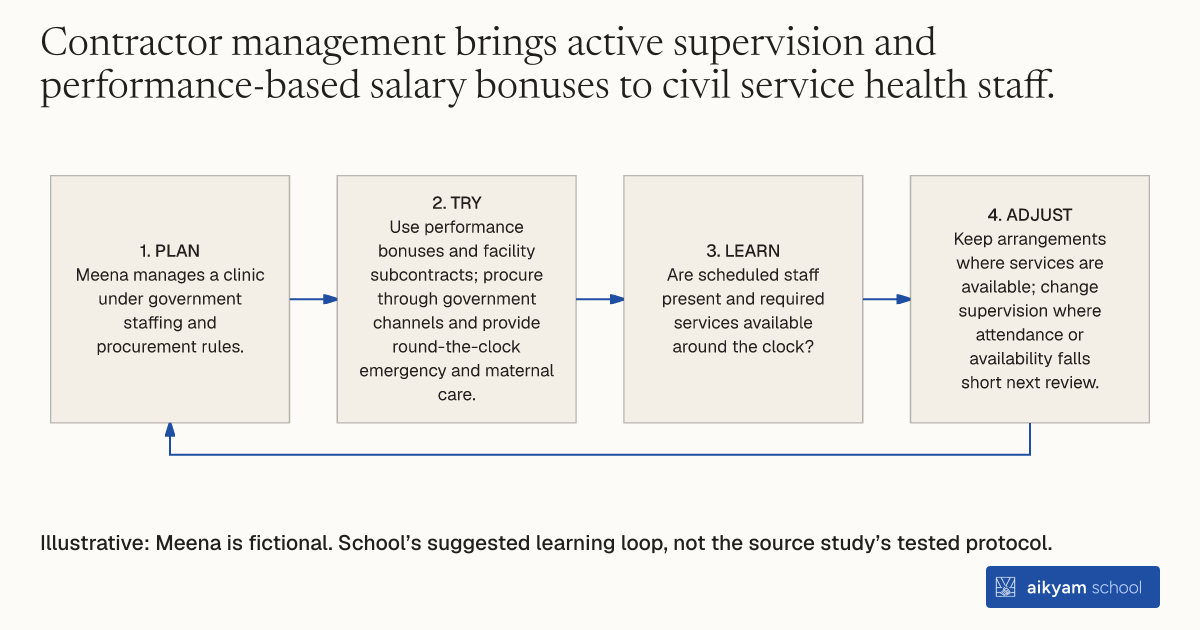
- Plan: Meena manages a clinic under government staffing and procurement rules.
- Try: Use performance bonuses and facility subcontracts; procure through government channels and provide round-the-clock emergency and maternal care.
- Learn: Are scheduled staff present and required services available around the clock?
- Adjust: Keep arrangements where services are available; change supervision where attendance or availability falls short next review.
Illustrative: Meena is fictional. School’s suggested learning loop, not the source study’s tested protocol.
See source →School’s suggested learning loop, not a tested source procedure. Observe staff presence and service hours; government staffing and procurement constraints remain part of this model.
How
When to use
Public health clinics in rural areas often suffer from high staff absenteeism, missing equipment, and poor service delivery. Local health managers working under standard civil service rules lack performance incentives and budget control. Contract in management by non-governmental organisations within existing government procurement and civil service systems to improve health center performance.
Contract with non-governmental organisations to manage district health services while keeping staff and procurement inside standard government channels.
- Award district health management contracts through a competitive two-envelope bidding process.
- Direct contractor managers to work within existing civil service rules for health center staff.
- Supplement government salaries using performance-based bonuses funded by contract budget supplements and formalized user fees.
- Procure all drugs, medical supplies, and equipment through normal government administrative channels.
- Require health facilities to provide round-the-clock emergency and maternal health care.
- Subcontract facility managers to manage local staff attendance and service targets.
Why it works
Formalized user fees and budget supplements fund staff incentives without violating government personnel rules.
Example
The Cambodian Ministry of Health contracted in district health management to HealthNet International in Pereang district and other non-governmental organisations across three districts from 1999 to 2003. Contractor managers provided staff salary supplements, introduced 24-hour service, and posted user fees. This increased round-the-clock service availability by 83 percentage points and increased public clinic visits for curative care by 18 percentage points.
About the study
Participants
12 rural districts across Takeo, Prey Veng, and Kampong Cham provinces in Cambodia, covering 1.26 million residents across 360 sample villages with 3,700 households and 143 health centers.
Study Design
Cluster-randomized trial evaluating 12 districts randomly assigned to contracting out, contracting in, or comparison status, using initial random eligibility as an instrumental variable for actual contract rollout.
Results
Contracting in increased 24-hour service availability by 83 percentage points, raised the presence of all scheduled staff by 50 percentage points, increased antenatal care visits by 36 percentage points, increased public health facility use by 18 percentage points, and improved overall targeted health outcomes by 0.51 standard deviations.