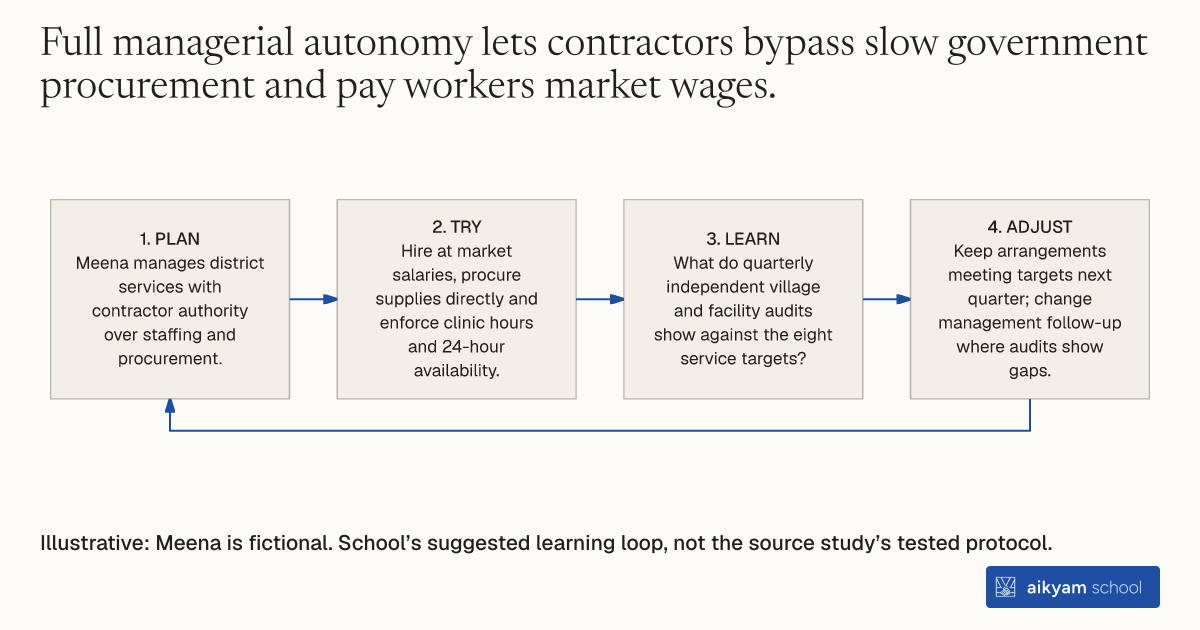
Try, learn and adjust
Check contracted-out service targets
- Plan: Meena manages district services with contractor authority over staffing and procurement.
- Try: Hire at market salaries, procure supplies directly and enforce clinic hours and 24-hour availability.
- Learn: What do quarterly independent village and facility audits show against the eight service targets?
- Adjust: Keep arrangements meeting targets next quarter; change management follow-up where audits show gaps.
Illustrative: Meena is fictional. School’s suggested learning loop, not the source study’s tested protocol.
See source →School’s suggested learning loop, not a tested source procedure. Observe independent audits, staff presence and service targets; this loop does not establish causal health effects.
How
When to use
Public health clinics in rural areas often suffer from high staff absenteeism and lack of basic supplies. Government oversight struggles to enforce staff attendance, while unregulated private providers give unnecessary treatments. Contract out district health management for rural populations to non-governmental organisations to establish reliable healthcare delivery.
Contract out the full management, staffing, and supply procurement of public health services in a district to non-governmental organisations.
- Put district health service management out to competitive tender among qualified non-governmental organisations.
- Transfer full authority over district hospitals, health centers, and health posts to the winning contractor.
- Hire health workers at market salaries and recruit managers from outside the local civil service.
- Procure all medicines, medical supplies, and equipment directly using private contractor channels.
- Enforce scheduled clinic hours and 24-hour availability using higher fixed salaries and the threat of dismissal.
- Monitor quarterly progress against eight primary health service targets using independent village and facility audits.
Why it works
Higher salaries combined with the authority to fire underperforming workers motivate staff to remain present and follow clinical guidelines.
Example
The Cambodian Ministry of Health contracted out management of public health services in two rural districts to international non-governmental organisations from 1999 to 2003. The contractors hired staff at market rates, supplied clinics directly, and enforced 24-hour service. This raised the presence of scheduled staff by 79 percentage points and reduced per capita out-of-pocket health spending by \$55.86.
About the study
Participants
12 rural districts in Takeo, Prey Veng, and Kampong Cham provinces in Cambodia, covering 1.26 million residents across 360 sample villages with 3,700 households and 143 health centers.
Study Design
Cluster-randomized trial evaluating 12 districts randomly assigned to contracting out, contracting in, or comparison status, using initial random eligibility as an instrumental variable for actual contract rollout.
Results
Contracting out increased the probability that all scheduled staff were present by 79 percentage points, increased public facility visits for curative care by 29 percentage points, raised child vitamin A coverage by 42 percentage points, improved targeted outcomes by 0.54 standard deviations, and reduced annualized individual out-of-pocket health spending by \$55.86.