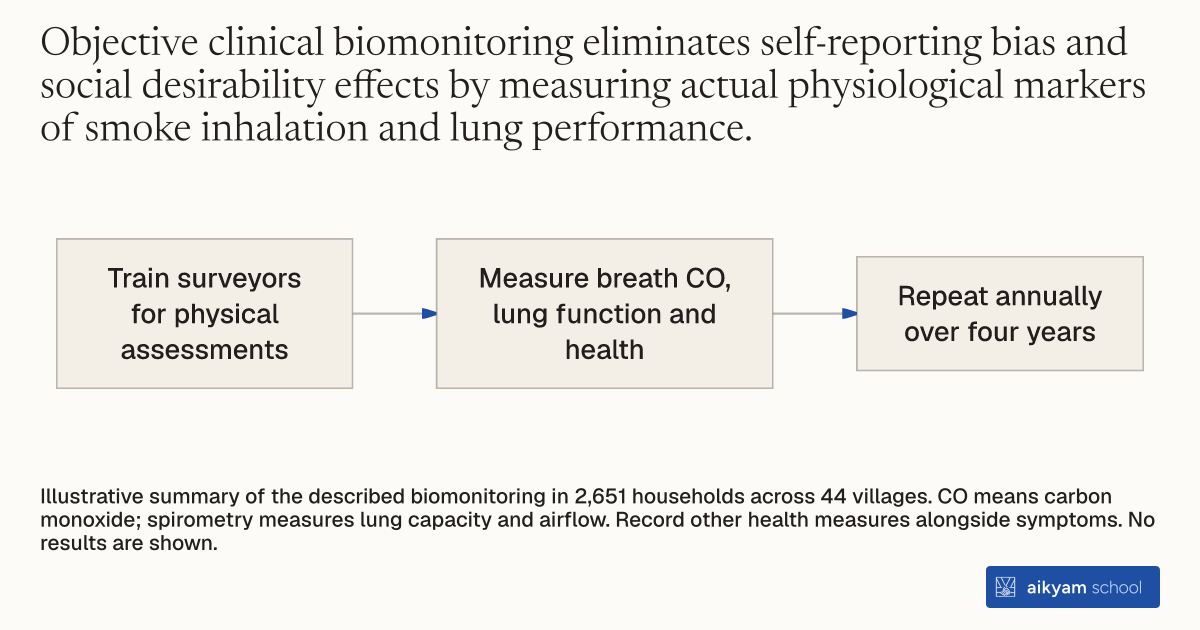
Research steps
Measure smoke exposure and lung function
- Train surveyors for physical assessments
- Measure breath CO, lung function and health
- Repeat annually over four years
Illustrative summary of the described biomonitoring in 2,651 households across 44 villages. CO means carbon monoxide; spirometry measures lung capacity and airflow. Record other health measures alongside symptoms. No results are shown.
See source →How
When to use
Evaluating clean cooking or indoor air quality interventions with subjective surveys often yields biased results. Self-reported health benefits fail to capture true physiological impacts of biomass smoke exposure. Program evaluators can use objective clinical tests to measure respiratory health and carbon monoxide exposure directly across household members.
Deploy trained surveyors to perform clinical health checks and biomonitoring tests directly across household members.
- Train field surveyors to conduct objective physical health assessments in participating communities, as J-PAL researchers did in Orissa.
- Measure carbon monoxide concentrations in exhaled breath for each household member using portable breath testing devices.
- Conduct spirometry tests on participants to quantify total lung capacity and measure air flow rate in and out of the lungs.
- Record supplementary health indicators including blood pressure, child body mass index, and infant mortality rates alongside self-reported health symptoms.
- Repeat clinical monitoring annually across multi-year follow-up waves to evaluate long-term physiological changes.
Example
Specially trained surveyors conducted exhaled carbon monoxide and spirometry lung tests on 2,651 participating households across 44 villages in Orissa over four years to evaluate biomass smoke health impacts.
About the study
Participants
2,651 participating households across 44 villages in Orissa, India.
Study Design
Four-year randomized controlled trial tracking carbon monoxide concentration in exhaled breath and spirometry lung functioning across family members.
Results
Exhaled carbon monoxide for primary cooks fell by 7.5 percent in year one with no change for other household members, and this reduction vanished by year two with zero improvements in measured lung functioning, blood pressure, child body mass index, or infant mortality rates.