Research evaluation
Link water orders with survey data
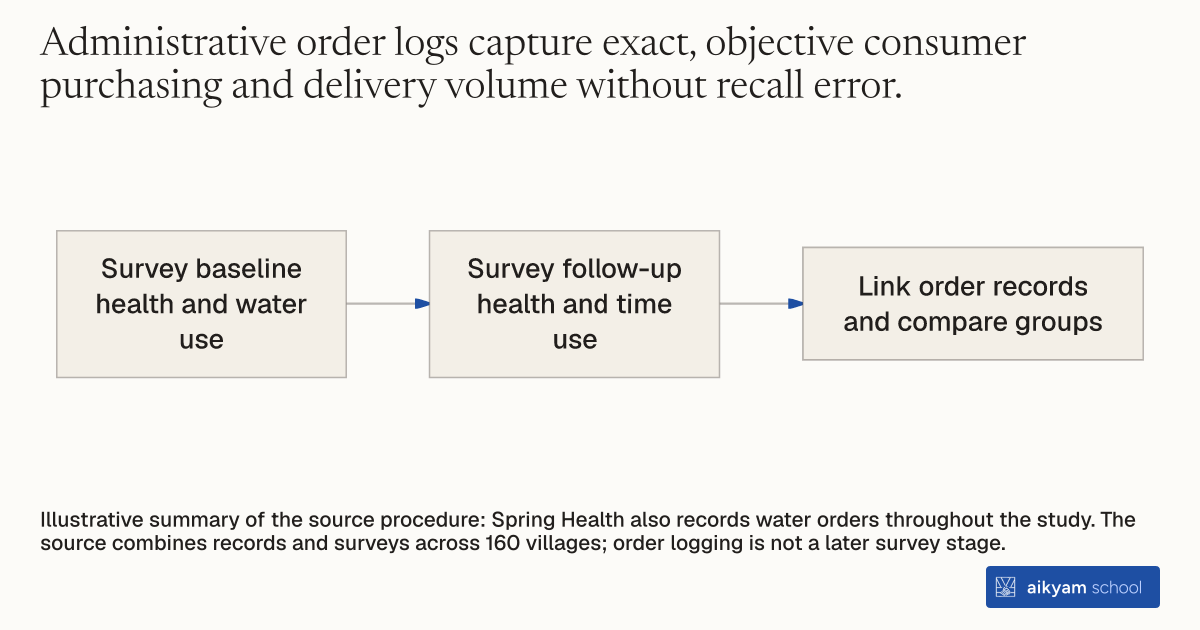
- Survey baseline health and water use
- Survey follow-up health and time use
- Link order records and compare groups
Illustrative summary of the source procedure: Spring Health also records water orders throughout the study. The source combines records and surveys across 160 villages; order logging is not a later survey stage.
See source →How
When to use
Development programs evaluating water infrastructure and health interventions require accurate measurement of consumer demand, time savings, and health impacts. Self-reported survey data alone can introduce recall bias, while administrative order records lack health and time-use context. Combining administrative order logs with household surveys provides rigorous, dual-source evaluation of program outcomes.
Combine company administrative order records with structured household surveys to measure program impact across health, consumption, and time allocation.
- Spring Health records all household water orders and quantities directly in administrative databases.
- Field researchers conduct baseline surveys measuring household demographics, water collection time, and initial water quality across study villages.
- Enumerators administer follow-up surveys to track household sickness, missed workdays, and health spending.
- Analysts link individual survey responses to administrative order records to verify consumption levels against health outcomes.
- Economists compare changes in health, time savings, and spending between treatment and comparison villages.
Why it works
Linking these records with household surveys enables researchers to isolate true health and economic impacts among active drinkers.
Example
Researchers evaluated Spring Health's water delivery across 60,000 households in 160 villages in rural Odisha, India, using administrative order logs and household surveys. The study revealed a 22 percent reduction in sickness and a 15 to 39 percent drop in water collection time relative to the 32-minute comparison baseline.
About the study
Participants
60,000 households across 160 villages in rural Odisha, India, with an average household size of five members and median bank balance of INR 2,000.
Study Design
Randomized controlled trial tracking 160 villages between May 2022 and August 2023, combining Spring Health administrative order logs with household surveys across four treatment groups.
Results
Documented a 22 percent reduction in sickness in priced water villages, a 15 to 39 percent drop in water collection time relative to the 32-minute comparison baseline, and up to 62 percent fewer missed workdays among reporting drinkers.