Try, learn and adjust
Check blood-group records support birth planning
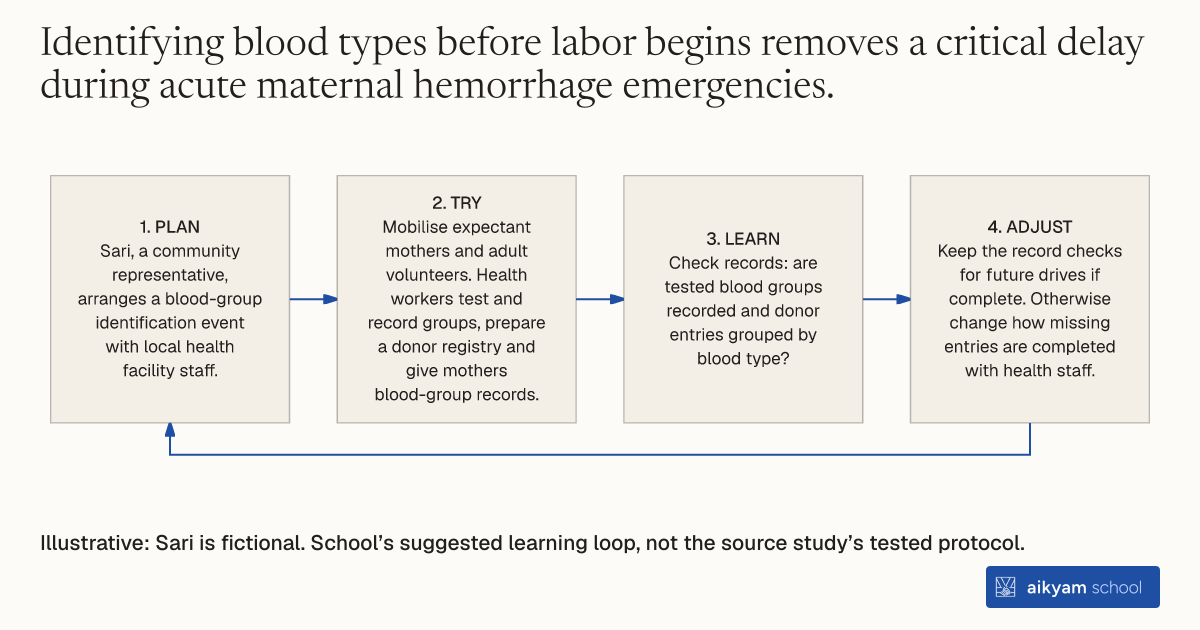
- Plan: Sari, a community representative, arranges a blood-group identification event with local health facility staff.
- Try: Mobilise expectant mothers and adult volunteers. Health workers test and record groups, prepare a donor registry and give mothers blood-group records.
- Learn: Check records: are tested blood groups recorded and donor entries grouped by blood type?
- Adjust: Keep the record checks for future drives if complete. Otherwise change how missing entries are completed with health staff.
Illustrative: Sari is fictional. School’s suggested learning loop, not the source study’s tested protocol.
See source →School's suggested, untested loop: observe blood-group records and registry entries. This is not a tested clinical protocol or evidence of transfusion safety.
How
When to use
Rural pregnant women face severe maternal complications like hemorrhage without knowing their blood type or having identified blood donors. Local community organizers need a proactive health preparedness drive to determine citizen blood groups before emergencies occur. Organizers execute this method to improve birth preparedness planning for expectant mothers.
Organize a community-wide blood testing drive to identify and record blood types for pregnant women and potential donors.
- Recruited community representatives meet with local health facility staff to schedule a village blood testing event.
- Mobilize community members and expectant mothers across sub-villages to attend the blood identification session.
- Health facility workers test and record the blood groups of attending pregnant women and adult community volunteers.
- Document a local registry of identified blood donors categorized by blood type for emergency maternal referrals.
- Provide blood type donor cards or records to pregnant women to include in their birth preparedness planning.
Why it works
Establishing a local registry of compatible donors enables rapid community blood donation when urgent transfusions are required.
Example
In rural intervention villages across Indonesia and Tanzania, community representatives organized blood type identification drives as part of maternal birth preparedness planning, representing 1.5% of community education and awareness actions across the 200 program villages.
About the study
Participants
200 rural treatment villages across two regions in Indonesia (100 villages) and two regions in Tanzania (100 villages).
Study Design
Two randomized controlled trials evaluating a non-prescriptive social accountability program, tracking social action plans and goal completion over a 90-day intervention period.
Results
Blood type identification drives were designed in 1.5% of intervention communities overall within the increased awareness, knowledge, and community attitudes pathway.