Research design
Randomise agricultural electricity feeders
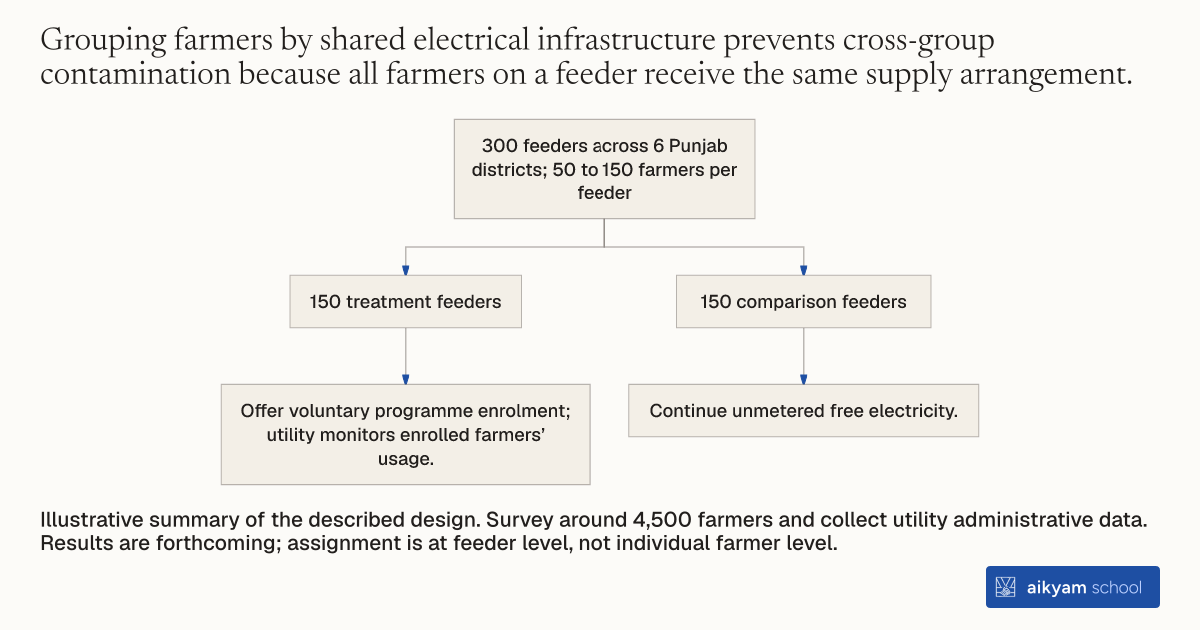
300 feeders across 6 Punjab districts; 50 to 150 farmers per feeder
- 150 treatment feeders
- Offer voluntary programme enrolment; utility monitors enrolled farmers’ usage.
- 150 comparison feeders
- Continue unmetered free electricity.
Illustrative summary of the described design. Survey around 4,500 farmers and collect utility administrative data. Results are forthcoming; assignment is at feeder level, not individual farmer level.
See source →How
When to use
Individual farmer-level policy evaluations face spillovers and tracking challenges when electricity flows through shared grid infrastructure. Researchers need a clean way to measure the true impact of a new agricultural policy across large rural networks. This method evaluates cluster-level policy interventions across shared infrastructure units without creating administrative confusion.
Evaluate a regional agricultural policy by randomizing shared infrastructure feeders into treatment and comparison groups.
- Identify 300 electrical feeders across six districts with severe groundwater scarcity in Punjab, India, where each feeder supplies power to 50 to 150 farmers.
- Randomly assign half of the feeders to a treatment group offered voluntary program enrollment and half to a comparison group receiving status quo unmetered electricity.
- Partner with the state power distribution utility to enroll farmers on treatment feeders and monitor their electricity usage.
- Survey approximately 4,500 farmers across treatment and control feeders to measure farming practices, political affiliations, and interest in the program.
- Collect administrative data to analyze energy consumption, natural resource impacts, agricultural production, and cost-effectiveness for potential state scaling.
Why it works
Collecting both administrative utility data and direct farmer surveys allows researchers to verify physical resource savings against reported agricultural practices.
Example
Researchers from J-PAL South Asia partnered with the Government of Punjab in India to evaluate the Paani Bachao, Paisa Kamaon program across 300 electrical feeders serving about 50 to 150 farmers each across 6 groundwater-scarce districts.
About the study
Participants
300 agricultural feeders supplying 50 to 150 farmers each across 6 districts in Punjab, India, with a follow-up survey of around 4,500 farmers.
Study Design
Cluster randomized controlled trial assigning 150 feeders to voluntary DBTE program enrollment and 150 feeders to unmetered free power status quo.
Results
Program evaluation is ongoing with results forthcoming; baseline groundwater extraction reached 149 percent of natural recharge while state power utility debt reached about US\$ 3 billion.