Research survey
Ask council members about behaviour
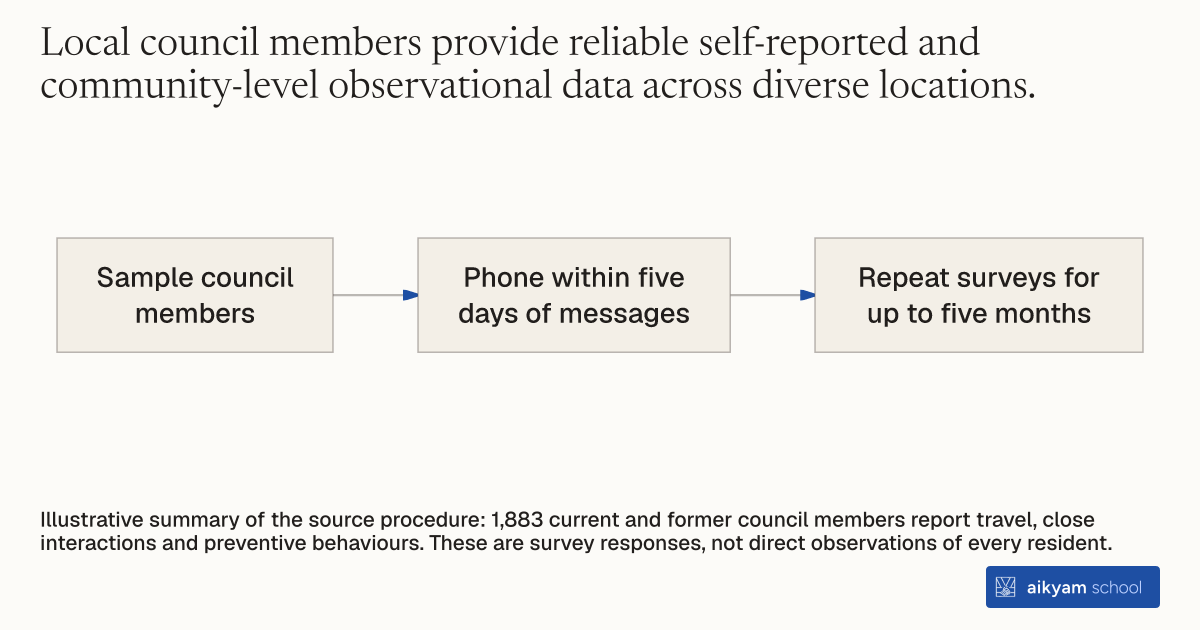
- Sample council members
- Phone within five days of messages
- Repeat surveys for up to five months
Illustrative summary of the source procedure: 1,883 current and former council members report travel, close interactions and preventive behaviours. These are survey responses, not direct observations of every resident.
See source →How
When to use
During health crises, public health researchers need to evaluate whether public messaging changes individual preventive behaviors across communities. Direct household surveys can be difficult or hazardous during active lockdowns or contagious outbreaks. Researchers can survey local village council members as representative community samples to measure social distancing, travel, mask usage, and handwashing behaviors.
Survey a random sample of current and former local village council members to evaluate population-level compliance with health recommendations.
- Research teams draw a random sample of 1,883 former and current local village council members across rural and urban postal index areas.
- Surveyors contact council members by phone within five days of public health messaging campaigns.
- Surveyors ask council members whether they recently traveled outside their village and count personal interactions within two arms' length.
- Surveyors ask council members about mask usage on outings, frequency of information exchange, symptom knowledge, and handwashing habits.
- Surveyors conduct continuous follow-up surveys with council members for up to five months to evaluate long-term behavior changes.
Why it works
Phone surveys with established local leaders enable rapid data collection during mobility restrictions without putting field staff at risk.
Example
In West Bengal, India, researchers surveyed 1,883 local village council members across postal index areas to measure health compliance following a video message intervention. Survey responses revealed that video recipients were 7.4 percentage points less likely to travel outside their village and washed their hands 4.7 percentage points more often upon returning.
About the study
Participants
1,883 former and current local village council members across rural and urban postal index areas in West Bengal, India.
Study Design
A randomized evaluation collecting phone survey data from village council members within five days of message dissemination, with continuous follow-up surveys over five months.
Results
Surveyed council members in video treatment areas were 7.4 percentage points (20 percent) less likely to travel outside their village, washed their hands 4.7 percentage points more often when returning home, and increased mask compliance from 97.8 percent to 99.7 percent.