Try, learn and adjust
Check energy rebate applications
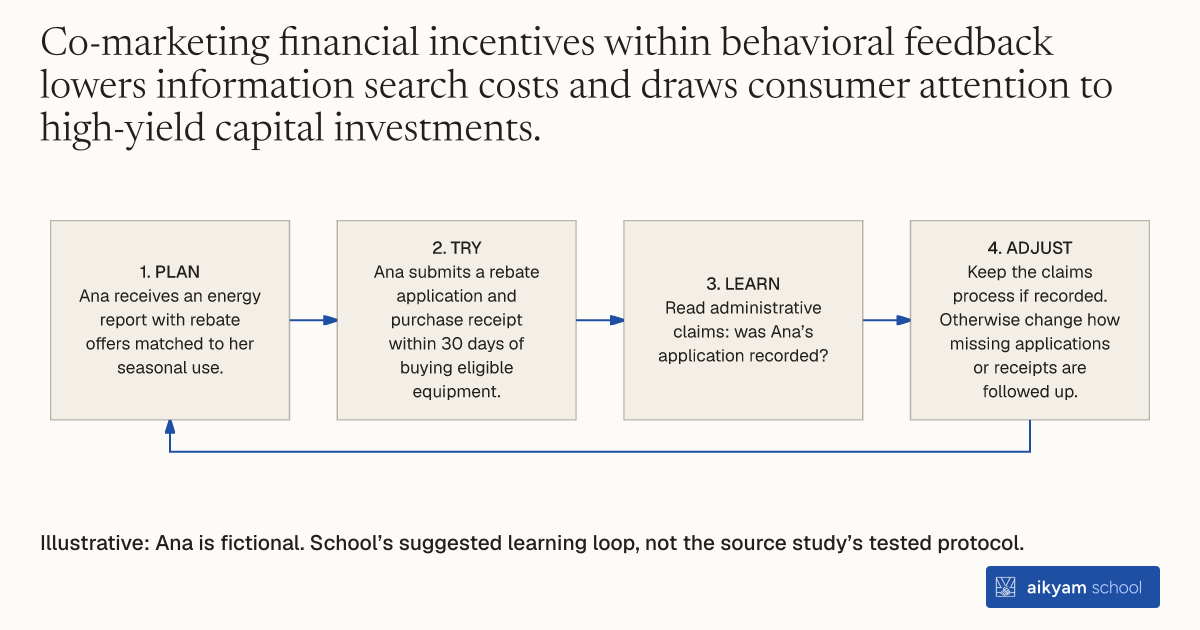
- Plan: Ana receives an energy report with rebate offers matched to her seasonal use.
- Try: Ana submits a rebate application and purchase receipt within 30 days of buying eligible equipment.
- Learn: Read administrative claims: was Ana’s application recorded?
- Adjust: Keep the claims process if recorded. Otherwise change how missing applications or receipts are followed up.
Illustrative: Ana is fictional. School’s suggested learning loop, not the source study’s tested protocol.
See source →School’s suggested learning loop: observe rebate offers, applications and receipts; this loop does not establish energy savings.
How
When to use
Electric utilities offer financial rebates to encourage residential customers to purchase energy-efficient physical capital like appliances, insulation, and heating systems. Low consumer awareness and administrative friction often limit voluntary enrollment in these cost-effective programs. Cross-marketing utility rebates through personalized home energy reports provides targeted promotional cues to boost household program participation.
Cross-promote utility-sponsored financial rebate programs within behavioral home energy reports to increase residential adoption of energy-efficient physical capital.
- Establish utility rebate offers for purchasing energy-efficient appliances, installing insulation, or upgrading heating and cooling systems.
- Embed personalized promotional modules and rebate application details into the action steps section on the back of home energy reports.
- Direct targeted rebate offers to specific households based on their seasonal electricity consumption patterns.
- Collect completed rebate applications and purchase receipts from participating households within 30 days of equipment purchase.
- Record administrative rebate claims to compare program take-up rates between report recipients and control households.
Example
In Site 3, a West Coast electric utility offered rebates of \$50 to \$75 for appliances, up to \$5,000 for insulation, and \$400 to \$2,000 for heating and cooling systems across 3,855 participating households.
About the study
Participants
234,000 single-family residential electricity customers across three utility sites in the Midwest, Northwest, and Southwest United States.
Study Design
Randomized control trial analyzing administrative rebate records across treatment households receiving home energy reports and control households over several years.
Results
Receiving home energy reports increased utility rebate program participation by 0.36 to 0.417 percentage points, explaining 2.40 to 14.2 Watt-hours per day of energy savings.