Research steps
Value cash and non-cash work
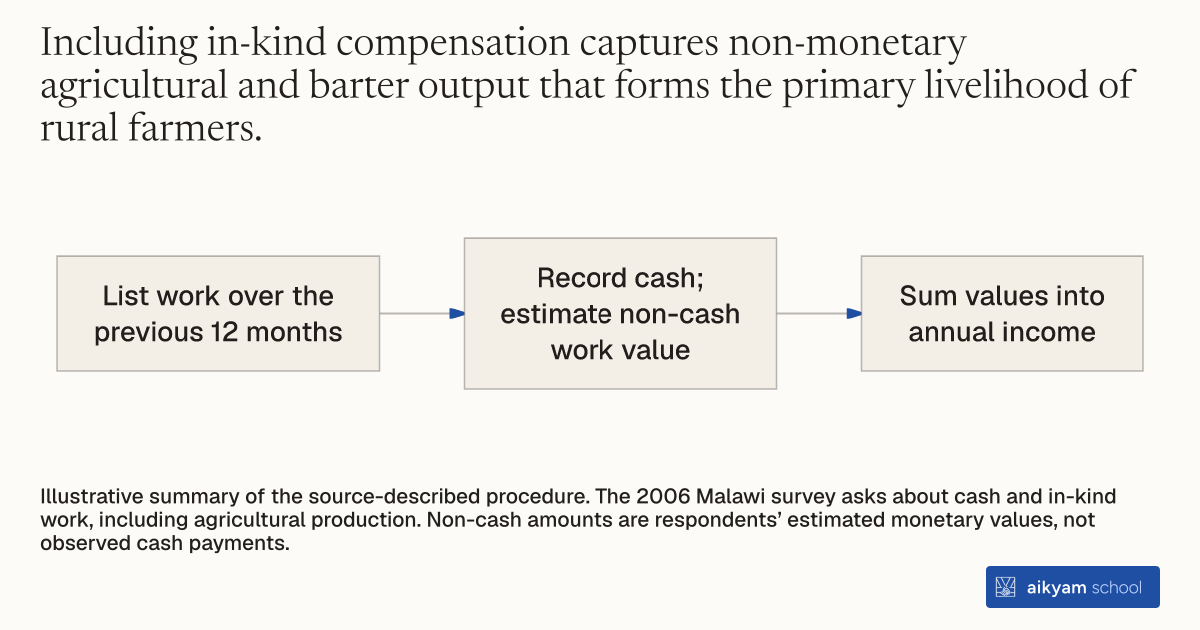
- List work over the previous 12 months
- Record cash; estimate non-cash work value
- Sum values into annual income
Illustrative summary of the source-described procedure. The 2006 Malawi survey asks about cash and in-kind work, including agricultural production. Non-cash amounts are respondents’ estimated monetary values, not observed cash payments.
See source →How
When to use
Rural households in developing nations engage heavily in subsistence agriculture and barter alongside casual wage labor. Measuring only monetary earnings misses crop production and non-cash compensation, underestimating household economic capacity. Combining cash payments with imputed monetary values for in-kind earnings provides an accurate total annual income measurement.
Calculate annual household income by measuring cash earnings and valuing in-kind compensation and agricultural production across all work activities over the preceding year.
- Survey enumerators interview respondents during household follow-up visits.
- Enumerators list all productive economic activities, paid wage work, and agricultural tasks undertaken by the respondent during the past twelve months.
- Enumerators record all direct cash payments earned from wage labor and enterprise.
- Enumerators prompt respondents to estimate the monetary market value of all in-kind goods, crops, and non-cash compensation received for work performed.
- Enumerators sum cash earnings and estimated in-kind valuations to construct an aggregated annual income variable.
Why it works
This comprehensive aggregation prevents systematic downward bias when evaluating economic well-being and intervention impacts.
Example
Enumerators interviewed 1,813 rural Malawians during the 2006 follow-up survey to calculate total annual income, combining cash and in-kind work value. Instrumental variable regressions showed that learning HIV-negative test results had no statistically significant effect on log income two years later.
About the study
Participants
1,734 HIV-negative adults in rural Malawi (41 percent male, average age 35 years, 4.9 years of education).
Study Design
Two-stage linear instrumental variables regression (2SLS) evaluating total log annual income across tested individuals, instrumented by randomized incentives and distance costs.
Results
Learning HIV-negative status produced a non-significant point estimate of 0.109 on log annual income (SE 0.194, minimum detectable effect size 0.322).