Research steps
Screen microentrepreneurs after a business census
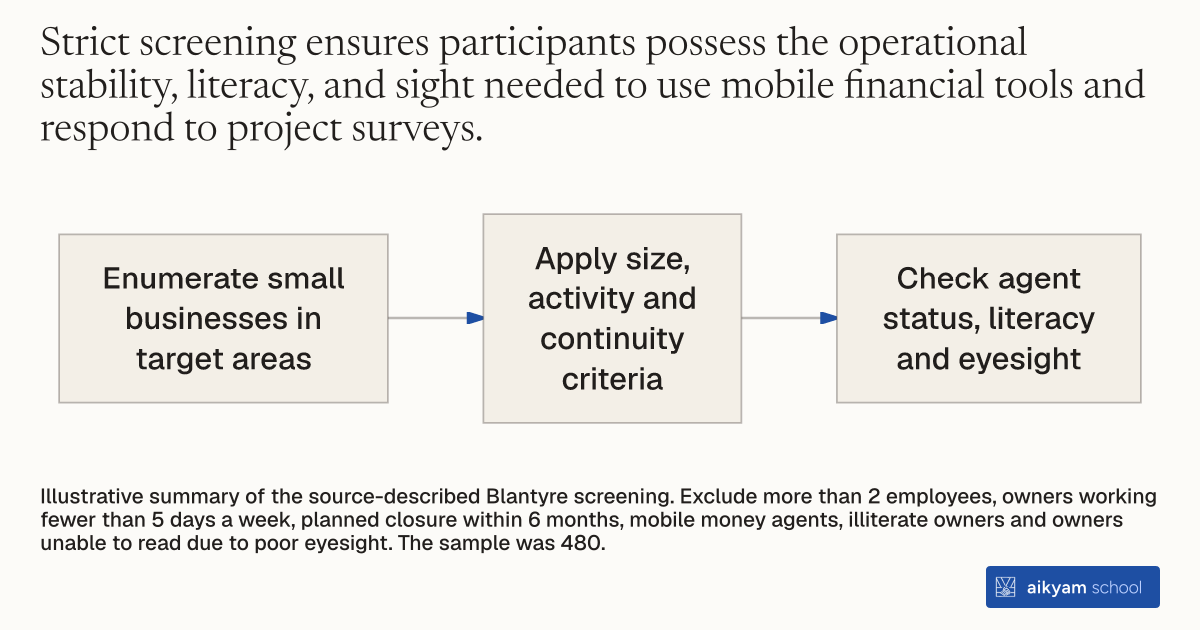
- Enumerate small businesses in target areas
- Apply size, activity and continuity criteria
- Check agent status, literacy and eyesight
Illustrative summary of the source-described Blantyre screening. Exclude more than 2 employees, owners working fewer than 5 days a week, planned closure within 6 months, mobile money agents, illiterate owners and owners unable to read due to poor eyesight. The sample was 480.
See source →How
When to use
Program managers need to identify eligible small business owners for financial inclusion programs in urban markets. Unfiltered populations include inactive businesses, illiterate owners, or enterprises planning early closure. Screening ensures selecting active entrepreneurs who can use financial tools and complete project activities.
Conduct a comprehensive census of small businesses in target areas and apply strict eligibility screening criteria.
- Enumerators conduct a full census of small businesses across commercial locations in Blantyre, Malawi.
- Exclude businesses with more than 2 employees to restrict the sample to microentrepreneurs.
- Exclude owners working fewer than 5 days a week to ensure regular business operation.
- Exclude businesses planning to shut down within 6 months to maintain study continuity.
- Exclude enterprises that already operate as mobile money agents.
- Exclude illiterate owners and owners who cannot read text due to poor eyesight.
Why it works
Selecting active microentrepreneurs focuses resources on business owners with real demand for cash management tools.
Example
Researchers conducted a business census in Blantyre, Malawi, excluding 6% of firms with over 2 employees, 9% with owners working under 5 days a week, 16% planning to shut down within 6 months, 3% mobile money agents, 20% illiterate owners, and 10% with poor eyesight, resulting in 480 eligible microentrepreneurs.
About the study
Participants
480 small-scale microentrepreneurs in Blantyre, Malawi.
Study Design
Field census of urban small businesses followed by multi-criteria inclusion screening on size, work days, firm lifespan, agent status, and literacy.
Results
The screening excluded 6% of businesses for size, 9% for low work days, 16% for planned shutdown, 3% for being agents, 20% for illiteracy, and 10% for poor eyesight, establishing a study sample of 480 respondents.