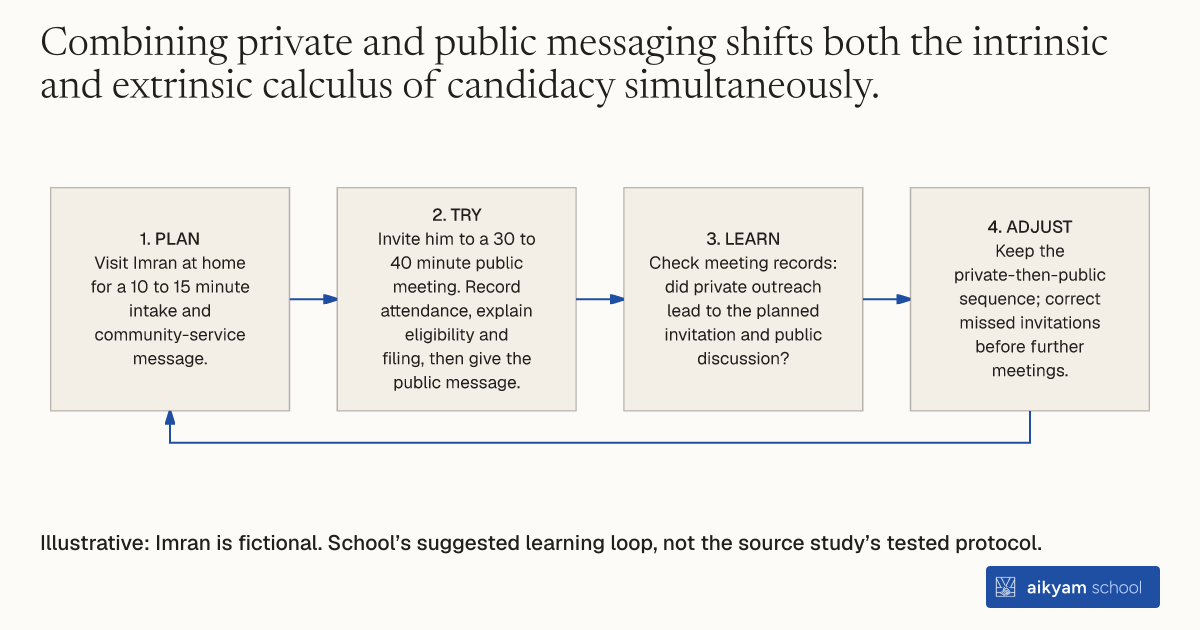
Try, learn and adjust
Check private outreach precedes the public meeting
- Plan: Visit Imran at home for a 10 to 15 minute intake and community-service message.
- Try: Invite him to a 30 to 40 minute public meeting. Record attendance, explain eligibility and filing, then give the public message.
- Learn: Check meeting records: did private outreach lead to the planned invitation and public discussion?
- Adjust: Keep the private-then-public sequence; correct missed invitations before further meetings.
Illustrative: Imran is fictional. School’s suggested learning loop, not the source study’s tested protocol.
See source →School’s suggested loop, not a tested source procedure. Observe outreach, attendance and discussion; do not infer candidacy or election gains from attendance.
How
When to use
Selfish motives often dominate political entry, discouraging public-spirited citizens from running for local office. Organizations combine one-on-one household visits with village-wide meetings to align both intrinsic and extrinsic motivations. This method targets prospective candidates and community members to maximize recruitment for local councils.
Deliver prosocial messaging in private individual visits and follow up with public village meetings to encourage political candidacy.
- Visit sampled male citizens at home to deliver a 10 to 15 minute private intake survey and prosocial script.
- Emphasize in the private visit that elected council members have an opportunity to serve the poor and improve village schools and clinics.
- Invite the citizen and other interested village residents to a central public meeting in the village.
- Assemble residents at a village landmark for a 30 to 40 minute public meeting and note attendance.
- Explain basic candidacy eligibility, filing requirements, and age criteria of 21 and above.
- Deliver the prosocial script publicly, highlighting that council members act as standard-bearers for local development.
- Address questions from the audience to enable community coordination around prospective candidates.
Why it works
Private visits boost personal intrinsic motivation, while public meetings signal prosocial intent to the community, enabling citizens to coordinate support around altruistic leaders.
Example
In Haripur and Abbottabad districts of Pakistan, field teams conducted both private one-on-one visits and public village meetings using social messaging across 24 villages. Delivering social encouragements in both private and public settings increased candidacy by 3.8 percentage points and election probability by 2.3 percentage points compared to personal status encouragements.
About the study
Participants
9,310 male citizens across 192 villages in Haripur and Abbottabad districts, Khyber Pakhtunkhwa province, Pakistan.
Study Design
A randomized field experiment comparing private, public, and combined social, personal, and neutral encouragement treatments across 12 geographic blocks, analyzing candidate filing records, election results, and municipal budget data.
Results
Delivering social messaging in both private and public settings increased candidacy by 3.8 percentage points (p = 0.002), increased election probability by 2.3 percentage points (p = 0.002), and reduced the Euclidean policy distance gap by 18.763 points (p = 0.024) compared to personal status messaging.