Research procedure
Compile full Form 14 election results
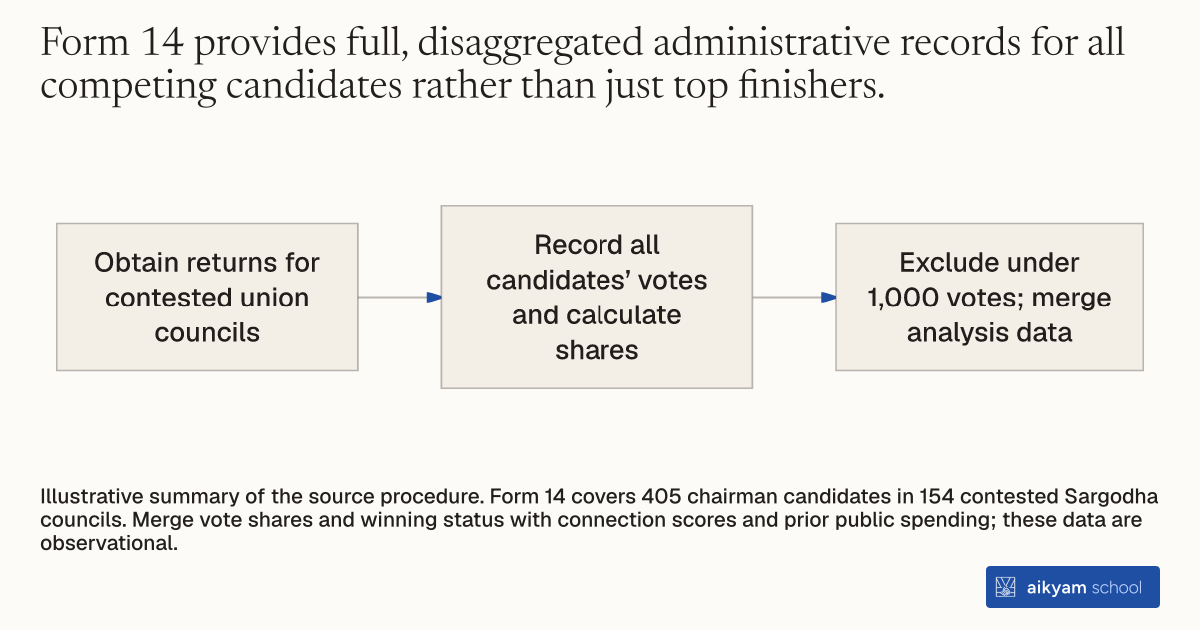
- Obtain returns for contested union councils
- Record all candidates’ votes and calculate shares
- Exclude under 1,000 votes; merge analysis data
Illustrative summary of the source procedure. Form 14 covers 405 chairman candidates in 154 contested Sargodha councils. Merge vote shares and winning status with connection scores and prior public spending; these data are observational.
See source →How
When to use
Researchers need detailed electoral outcome data for all candidates in local elections to analyze vote shares and electoral competitiveness. Standard gazetted election summaries only record vote totals for winners and runners-up, obscuring full candidate distributions and turnout. This method extracts complete polling station and constituency metrics from official regulatory reporting forms.
Track and analyze local election outcomes by auditing official Form 14 documents from district election offices.
- Obtain official Form 14 documents for all contested union councils from the local district office of the election commission.
- Extract the total number of registered voters, total votes cast, and valid votes polled for every union council.
- Record vote totals and calculate individual vote shares for all candidates contesting each union council chairman seat.
- Filter out non-serious contenders polling under 1,000 votes to restrict analysis to competitive candidates.
- Merge candidate vote shares and winning statuses with candidate connectedness scores and prior public spending data.
Why it works
This complete electoral accounting enables precise econometric estimations of vote shares and winning probabilities across experimental and observational arms.
Example
Researchers collected Form 14 records across 154 contested union councils in Sargodha district following the November 2015 local elections, capturing vote totals for all 405 chairman candidates and finding that the top two candidates were competitive in 76 percent of councils.
About the study
Participants
Official election returns for 405 chairman candidates across 154 contested union councils in Sargodha district, Punjab province, Pakistan.
Study Design
Observational audit of administrative Form 14 election returns obtained from the District Election Commission of Sargodha.
Results
Election winners polled an average of 2,955 votes while runners-up averaged 2,335 votes, with candidates at the top of the aggregate connectedness index securing a 9.5 percentage point higher vote share and a 26 percentage point higher probability of winning office.