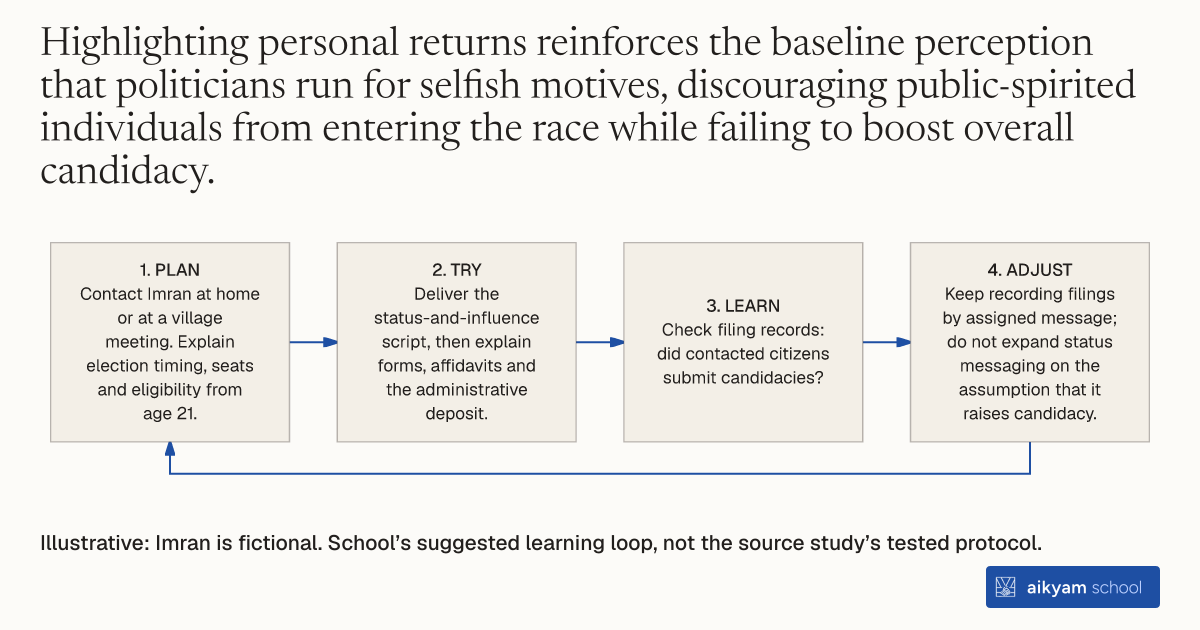
Try, learn and adjust
Check the status message follows election information
- Plan: Contact Imran at home or at a village meeting. Explain election timing, seats and eligibility from age 21.
- Try: Deliver the status-and-influence script, then explain forms, affidavits and the administrative deposit.
- Learn: Check filing records: did contacted citizens submit candidacies?
- Adjust: Keep recording filings by assigned message; do not expand status messaging on the assumption that it raises candidacy.
Illustrative: Imran is fictional. School’s suggested learning loop, not the source study’s tested protocol.
See source →School’s suggested loop, not a tested source procedure. Observe filings and election records. The source reports lower candidacy relative to neutral messages, with uncertainty.
How
When to use
In many democracies, public office is perceived as a vehicle for private advancement, prestige, and personal network building. Organizations or field teams test status-driven messaging to evaluate whether framing political office around personal returns motivates citizens to contest local office. This method targets eligible residents during candidate recruitment drives for local village councils.
Deliver personal status and influence messaging during private household visits or public village meetings to encourage citizens to run for local political office.
- Contact sampled adult citizens at their dwellings or assemble residents in a central village venue.
- Share neutral information regarding upcoming election dates, open council seats, and basic eligibility requirements for citizens aged 21 and above.
- Deliver a script highlighting that elected office offers an opportunity to gain respect, status, and local influence.
- Explain that council members build connections with higher-level politicians, creating political advancement opportunities for themselves and their families.
- Provide instructions on acquiring election forms, preparing non-defaulter affidavits, and paying the required administrative deposit.
Example
In Haripur and Abbottabad districts of Pakistan, enumerators delivered personal status messaging across 72 villages in private and public settings. Relative to neutral information alone, personal status messaging reduced candidacy by 0.9 percentage points and reduced election rates by 0.7 percentage points among sampled citizens.
About the study
Participants
9,310 male citizens across 192 villages in Haripur and Abbottabad districts, Khyber Pakhtunkhwa province, Pakistan.
Study Design
A randomized field experiment comparing personal, social, and neutral encouragement treatments across 12 geographic blocks, analyzing candidate filing records, election results, and municipal budget data.
Results
Highlighting personal benefits reduced candidacy by 0.9 percentage points (p = 0.107) and election probability by 0.7 percentage points (p = 0.057) relative to neutral messages, while increasing the Euclidean policy distance gap by 2.361 points (p = 0.322).