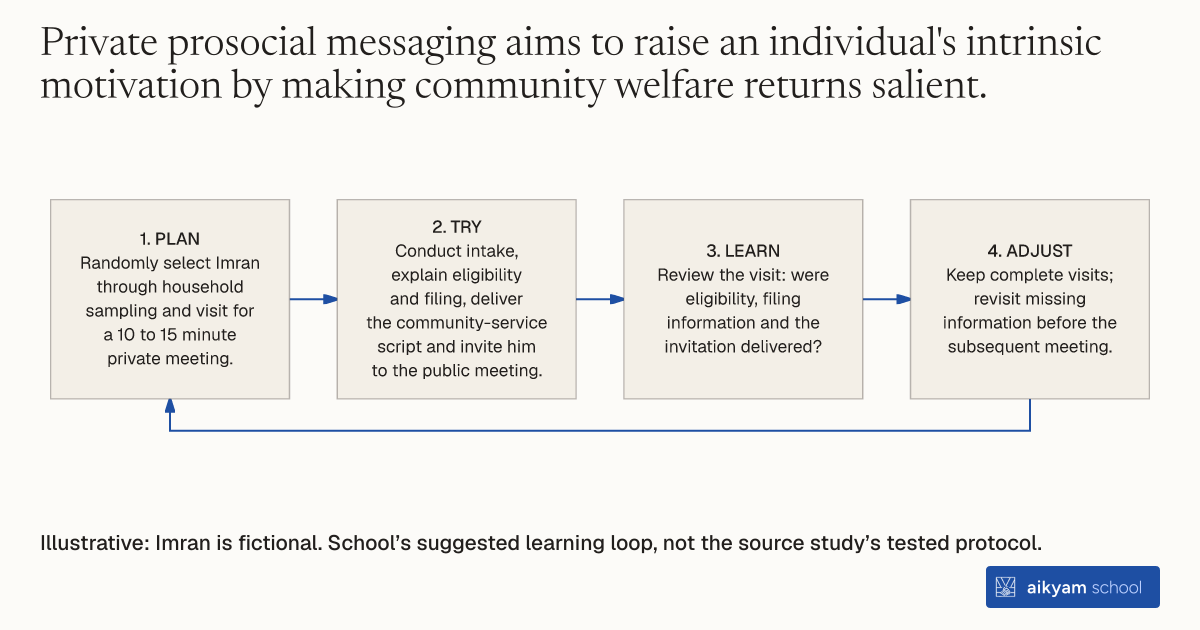
Try, learn and adjust
Check private outreach and the meeting invitation
- Plan: Randomly select Imran through household sampling and visit for a 10 to 15 minute private meeting.
- Try: Conduct intake, explain eligibility and filing, deliver the community-service script and invite him to the public meeting.
- Learn: Review the visit: were eligibility, filing information and the invitation delivered?
- Adjust: Keep complete visits; revisit missing information before the subsequent meeting.
Illustrative: Imran is fictional. School’s suggested learning loop, not the source study’s tested protocol.
See source →School’s suggested loop, not a tested source procedure. Observe visit content and invitations. The source found no candidacy or election increase from private messages alone.
How
When to use
Selfish motives often dominate political entry, discouraging public-spirited citizens from running for local office. Organizations try one-on-one meetings to privately persuade qualified community members to enter local politics. This approach tests whether appealing to private altruistic motivation alone moves citizens to run for new village councils.
Deliver prosocial scripts in private one-on-one visits to encourage citizens to run for local political office.
- Select a random sample of citizens from household walks starting at the village center.
- Visit each selected citizen at their dwelling for a 10 to 15 minute private meeting.
- Conduct a short intake survey with the prospective candidate.
- Explain council structures, election timing, age eligibility of 21 and above, and filing procedures.
- Deliver a prosocial script emphasizing that elected members receive an excellent opportunity to help poor residents and improve local health and school facilities.
- Invite the prospective candidate to a subsequent public village meeting.
Why it works
Without a public signal, however, private nudges do not alter how community members view a candidate's motives.
Example
In Haripur and Abbottabad districts of Pakistan, enumerators visited male citizens at home to privately encourage candidacy for local village councils. Delivering social encouragements in private meetings alone did not increase candidacy or election probabilities compared to neutral messages or personal status messages.
About the study
Participants
9,310 male citizens across 192 villages in Haripur and Abbottabad districts, Khyber Pakhtunkhwa province, Pakistan.
Study Design
A randomized field experiment comparing private and public social, personal, and neutral encouragement treatments across 12 geographic blocks, analyzing candidate filing records, election results, and municipal budget data.
Results
Delivering social messaging in private meetings alone produced a 0.9 percentage point decrease in candidacy (p = 0.195), a 0.2 percentage point decrease in election probability (p = 0.419), and a 0.097 point increase in the Euclidean distance between official budget spending and citizen preferences (p = 0.496) relative to neutral messages.