Research steps
Track adolescent survey participants
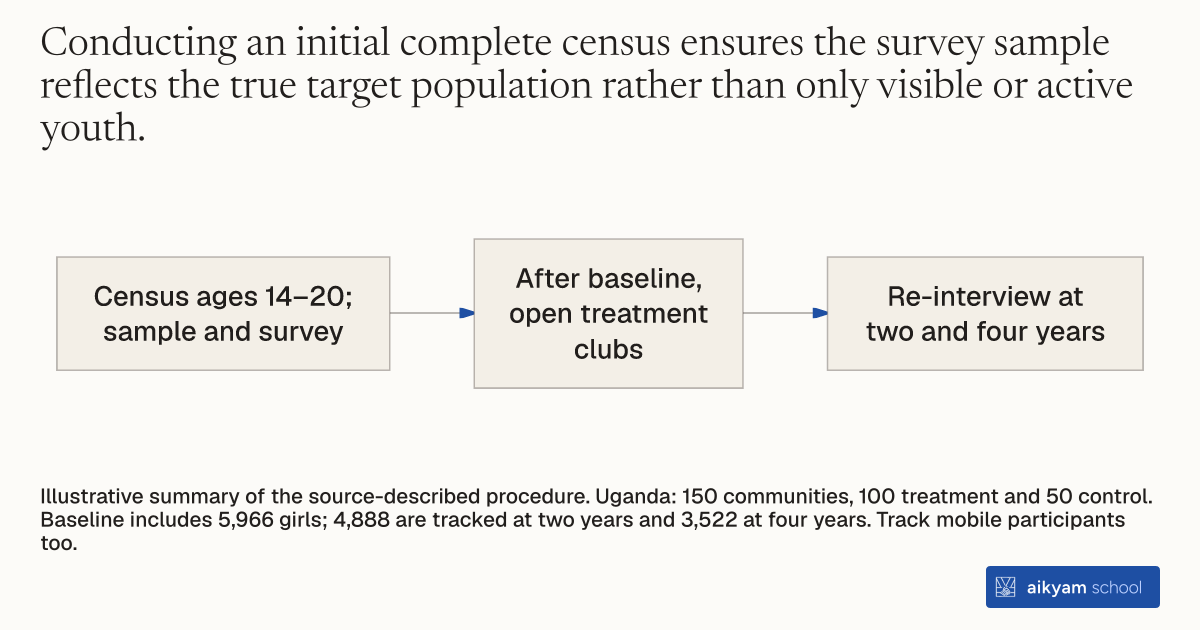
- Census ages 14–20; sample and survey
- After baseline, open treatment clubs
- Re-interview at two and four years
Illustrative summary of the source-described procedure. Uganda: 150 communities, 100 treatment and 50 control. Baseline includes 5,966 girls; 4,888 are tracked at two years and 3,522 at four years. Track mobile participants too.
See source →How
When to use
High geographical mobility among adolescent girls makes evaluating long-term community programs difficult. Researchers risk biased findings if mobile youth drop out of tracking surveys at high rates. Conduct a full community census followed by longitudinal sampling and field tracking to identify and retain a representative cohort.
Conduct a complete community census of eligible young women to draw representative samples and track participants across multi-year follow-up waves.
- Enumerators survey all households in evaluation communities to list every resident adolescent girl aged 14 to 20.
- Field managers draw a random sample of approximately 40 eligible girls per community from the census listing.
- Surveyors administer a comprehensive baseline survey covering employment, health, educational investment, time use, and aspirations.
- Program staff deploy ELA youth clubs in treatment communities following baseline completion.
- Surveyors re-interview sampled girls two years post-intervention for midline data collection.
- Field teams track geographically mobile adolescents to conduct four-year endline follow-up surveys.
Why it works
Repeated tracking across long time horizons maintains representative panel data even in contexts with high youth geographic mobility.
Example
Researchers conducted a census across 150 communities in Uganda in early 2008, identifying about 130 eligible girls per community. They drew a random sample of 5,966 adolescent girls for baseline surveys and successfully tracked 4,888 girls (82%) at two-year midline and 3,522 girls (59%) at four-year endline.
About the study
Participants
4,888 adolescent girls tracked at midline and 3,522 at endline across 150 communities in Kampala, Mukono, Iganga, and Jinja, Uganda, with average baseline age of 16.3 years.
Study Design
Cluster randomized control trial across 150 communities (100 treatment, 50 control) stratified by 10 branch offices, evaluating outcomes at baseline, midline (2 years), and endline (4 years) using OLS ANCOVA and Lee bounds.
Results
Four years post-intervention, engagement in income-generating activities increased by 48%, self-employment rates rose by 50%, teen pregnancy fell by 34%, early marriage/cohabitation dropped by 62%, and reporting sex against will decreased by 31%.